
Eyes that sting by evening, feel gritty after a day of spreadsheets, or start a headache behind the brows are now common across age groups, from schoolchildren on online classes to grandparents watching reels. The Eye Care (Akshi Tarpan) Programme is a 7-sitting Ayurvedic course for ₹8,000 that nourishes tired eyes with warm medicated ghee and supporting face, nasal, mouth and foot therapies.
Quick answer
The Eye Care (Akshi Tarpan) Programme at Vedic Panchakarma, Sarnath, Varanasi costs ₹8,000 for 7 sittings and combines Akshi Tarpan (medicated ghee held over the open eyes) with Face Lymphatic Drainage, Mukha Swedan, Nasya, Kawal and Padabhyanga for screen strain, dry or burning eyes and eye-related headaches.
- 7 sittings, around 75-90 minutes each
- ₹8,000 for the complete programme
- Akshi Tarpan is the central therapy in every sitting
- First consultation with Nadi Pariksha (₹500) is booked separately
- Open all seven days, 9 AM to 8 PM, Old RTO Chauraha, Sarnath
Reserve your slot for this package
Leave your number. We call you back during clinic hours to confirm your plan, dates and price.
Special offer for everyone who downloads the app and books or takes a treatment. Get it on Google Play
Whose eyes need this programme
In Ayurveda, the eyes are a seat of Alochaka Pitta, the aspect of Pitta responsible for vision. Long hours of focusing on a bright screen, dust, late nights and dehydration are thought to heat and dry this area, producing burning, redness and fatigue. Akshi Tarpan, meaning “satisfying the eyes”, is the classical way of cooling and nourishing them.
The programme is usually chosen by:
- Software engineers, accountants, designers and call-centre staff who spend most of the day on a screen
- College students and aspirants studying late from mobile phones or tablets
- People with dry, gritty or watery eyes, especially in the dusty, dry months
- Those who get frontal headaches or heaviness behind the eyes after reading
- Drivers who face highway glare and night-time headlights
When eye strain is part of a bigger picture of poor sleep and constant worry, the doctor may suggest pairing it with, or choosing instead, the Stress Relief Rejuvenation package.
Step by step through a sitting
Face Lymphatic Drainage (10-15 minutes)
Soft, rhythmic strokes move from the centre of the face towards the ears and down the neck. This eases puffiness under the eyes and relaxes the small muscles of the forehead and temples that tighten during screen work.
Mukha Swedan (5-10 minutes)
Mild herbal steam is directed at the face, with the eyes kept closed and protected. It opens the pores and warms the area so the following therapies are more comfortable.
Nasya (about 10 minutes)
A few drops of medicated oil are instilled into each nostril. Ayurveda regards the nose as the route to the head, and Nasya is traditionally used to relieve heaviness and headaches that involve the eyes and sinuses. Read more on our Nasya page.
Kawal (about 5 minutes)
You take a mouthful of warm medicated liquid, swish it actively around the mouth for a few minutes and then spit it out. Kawal is said to support the sense organs of the head and leaves the mouth and throat refreshed.
Akshi Tarpan (20-25 minutes)
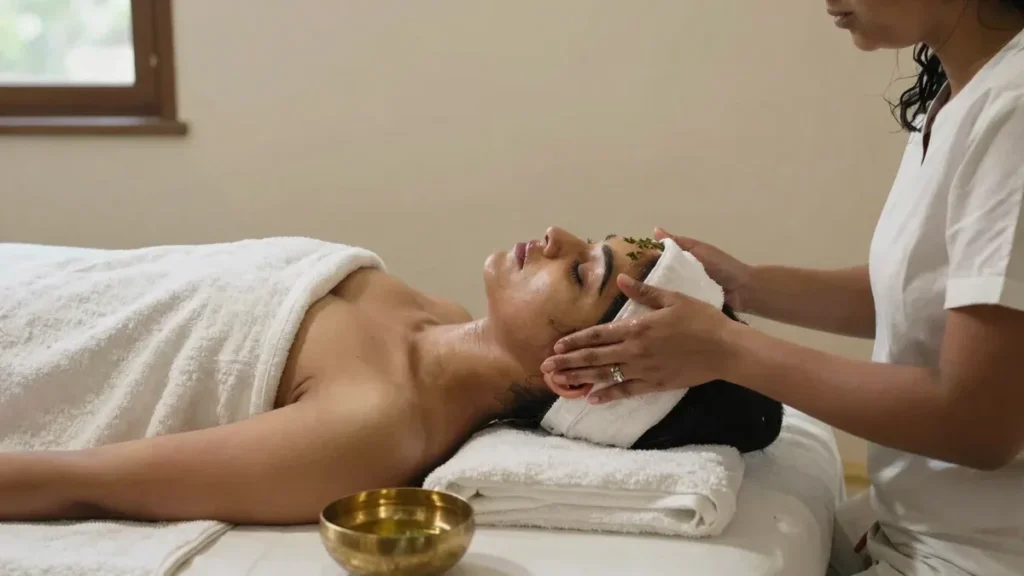
You lie on your back while a small, leak-proof wall of black gram dough is shaped around each eye socket. Lukewarm medicated ghee, often Triphala Ghrita or a similar preparation chosen by the doctor, is poured in slowly until it covers the closed eyelids. You are then asked to open and close your eyes gently, so the ghee bathes the eye surface. Vision feels blurred and oily during the therapy; this clears within a short while after the ghee is drained and the area is cleaned.
Padabhyanga (15 minutes)
The sitting ends with an oil massage of the feet and lower legs. Ayurvedic texts describe a connection between the soles and the eyes, and foot massage has long been recommended to keep the eyes cool and the mind settled.
Seven-sitting schedule
| Sitting | Therapies | Approx. time |
|---|---|---|
| 1 | Face Lymphatic Drainage, Mukha Swedan, Nasya, Kawal, Akshi Tarpan, Padabhyanga; comfort with ghee checked | About 90 minutes |
| 2-3 | Same sequence; Tarpan time increased gradually if comfortable | 75-90 minutes |
| 4-5 | Same sequence; screen-break and blinking habits reviewed | 75-90 minutes |
| 6 | Same sequence | 75-90 minutes |
| 7 | Final sequence; home eye-care routine explained | 75-90 minutes |
Sittings may be taken on consecutive days or as advised by the doctor.
What patients tend to notice
A soothing, cool feeling around the eyes is common right after the first Akshi Tarpan. Over the week, many patients say their eyes feel less dry and gritty, they blink more comfortably and they reach the end of a workday with less burning. Headaches linked to eye strain may become less frequent.
The programme supports comfort and eye surface health. It does not change your spectacle power, remove cataracts or treat glaucoma or retinal disease, and you should keep up regular check-ups with an ophthalmologist.
Eye-friendly habits and food
- Follow the 20-20-20 rule: every 20 minutes, look at something 20 feet away for 20 seconds
- Splash your closed eyes with clean, cool water after returning home, especially in the hot, dusty months
- Include amla, either fresh, as murabba or as a mild juice, and a little desi ghee in meals
- Eat seasonal green vegetables such as palak, methi and bathua, and carrots from the winter market
- Limit very spicy, sour and fried foods, and late-night tea or coffee, which tend to increase Pitta
- Sleep for seven to eight hours and keep the phone away for the last half hour before bed
On sitting days, wear sunglasses on the way home and avoid riding into dust or wind with uncovered eyes.
Precautions
Akshi Tarpan is gentle, but it is not appropriate in every situation. Please inform the doctor if you have:
- A red, sticky or infected eye (conjunctivitis), a stye or an eye injury
- Had cataract, LASIK or any other eye surgery recently
- Glaucoma, retinal problems or sudden changes in vision, which need an eye specialist first
- Fever, cold or blocked sinuses, when Nasya is generally deferred
- Pregnancy, so the therapy selection can be reviewed
Remove contact lenses before the session and bring your spectacles for the journey home.
Price and inclusions
The Eye Care (Akshi Tarpan) Programme costs ₹8,000 for 7 sittings. Included are Face Lymphatic Drainage × 7, Nasya × 7, Mukha Swedan × 7, Kawal × 7, Akshi Tarpan × 7 and Padabhyanga × 7. The first consultation with Nadi Pariksha costs ₹500 and is separate, as are any eye drops or oral medicines the doctor may prescribe. See our pricing page for individual therapies and the packages page for other programmes.
Choose how you pay
Same therapies, same doctor, same time per sitting. Full package: pay ₹8,000 once and save ₹1,450 (15%). Day-wise: ₹1,350 per day, paid at each visit.
Getting started
Book a ₹500 consultation with Dr. Komal Maurya, who will ask about your screen time, symptoms and any eye conditions before confirming the plan. Your first Akshi Tarpan can follow the same day. The clinic runs every day from 9 AM to 8 PM, so after-office sittings are easy to arrange. WhatsApp 96822 22121 to book, or find out more about our Ayurvedic doctor in Varanasi.
Frequently asked questions
What is the cost of Akshi Tarpan in Varanasi?
At Vedic Panchakarma, Sarnath, the Eye Care (Akshi Tarpan) Programme costs ₹8,000 for 7 sittings, including Akshi Tarpan and five supporting therapies each time. The first consultation is ₹500.
Does Akshi Tarpan hurt or sting?
It should not hurt. The ghee is lukewarm and vision feels blurry and oily while it is on the eyes, which clears after the eyes are cleaned.
Can Akshi Tarpan reduce my spectacle number?
No reliable claim can be made that it changes spectacle power. It is used to support comfort for dry, tired and strained eyes.
Can I use my laptop after the session?
It is better to rest your eyes for a couple of hours after Akshi Tarpan. If you must work, keep screen brightness low and take frequent breaks.
Is it safe to continue my eye drops?
Yes, continue drops prescribed by your eye doctor, but tell us which ones you use. The doctor will advise how to time them around the therapy.
Is this suitable for children with screen strain?
Older children can often take parts of the programme after the doctor assesses them. Parents should discuss suitability at the consultation.
Ask about this package
Spend long hours on screens? Ask us whether Akshi Tarpan is right for you.
Please read: Akshi Tarpan and related therapies offer supportive care for eye comfort and are no substitute for regular examination and treatment by an ophthalmologist. Results differ from one person to another. Reviewed by Dr. Komal Maurya, BAMS.
What our patients say
Had a really good experience at Vedic Panchakarma with Dr. Komal Maurya. I tried Shirodhara and cupping therapy, and both sessions were very relaxing and refreshing. Dr. Komal was kind, patient, and made sure I was comfortable throughout the treatments. She explained everything nicely and gave personal attention.
The overall atmosphere was peaceful and welcoming. I genuinely enjoyed the experience and would definitely recommend Vedic Panchakarma to anyone looking to try Ayurvedic therapies and take some time out for self-care.
Thank you, Dr. Komal, for such a lovely experience! 😊
I had a very good experience at Vedic Panchkarma. The doctor is very kind, polite, and supportive. She listens to every concern patiently and explains everything clearly. The staff is also very friendly and helpful, and the centre is clean, peaceful, and well-maintained. Overall, a wonderful experience. Highly recommended! 😊😊
I am from Lucknow, facing back pain after c-section and visited Vadic Panchkarma. Dr. Komal recommended sneha, swedan and potali panchkarma.