Walk down any lane off Godowlia and someone will sell you the line that Ayurveda was born in Kashi. Most writing on ayurveda history varanasi repeats it without a single date attached. That is a pity, because the city does not need the vague version. It has one specific claim that stands up better than almost anything Kerala or Ujjain can offer, and it is worth separating that claim from the fog around it.
What follows marks legend as legend and history as history, line by line, and says plainly where the scholars disagree.
Quick answer
Ayurveda history in Varanasi rests on one strong claim: the Sushruta Samhita, the founding text of Indian surgery, presents itself as the teaching of Divodasa, king of Kashi, received by his student Sushruta. Kashi later became a manuscript and Sanskrit-teaching city, and BHU now houses a full Faculty of Ayurveda.
- Divodasa of Kashi is named in the text itself, not invented later.
- Dhanvantari as a god who rose from the ocean is theology, not history.
- Scholars date the Sushruta Samhita anywhere from 1000 BCE to 500 CE.
- Ayurveda was taught at the Benares Sanskrit College from 1791.
- BHU runs a two-year PG diploma in Panchakarma Therapy today.
The one claim Kashi can actually stand behind
The Sushruta Samhita is not set in some unnamed forest hermitage. It is set here. The text is framed as a dialogue in which Sushruta and other pupils come to a teacher and ask to be taught surgery, and that teacher is Divodasa, king of Varanasi.
Here is the detail that matters, and almost nobody quotes it. Printed editions carry the phrase “as Lord Dhanvantari declared”, attaching the teaching to the god of medicine. But the earliest surviving manuscripts omit that attribution and frame the work as the teaching of Divodasa, king of Varanasi. The divine layer looks like something added on the way down, not something original.
There is corroboration from outside the Ayurvedic tradition too. Early Buddhist Jataka literature refers to a Divodasa who lived and taught as a physician in ancient Kashi. Two separate literary streams, two different religious communities, one city.
Where the legend stops and the history starts
This is the distinction that most Varanasi Ayurveda pages refuse to draw, so let us draw it hard.
- Legend. Dhanvantari rising from the churning of the ocean holding the pot of amrita. That is Puranic theology. It is beautiful and it is not a historical event.
- Legend, sincerely held. Dhanvantari incarnating as the king of Kashi. This is the tradition’s own way of joining the god to the man.
- Tradition with historical texture. Divodasa as a real teacher of surgery in Kashi. Attested in the medical text and echoed in the Jatakas, but not archaeologically verifiable.
- History. The Sushruta Samhita exists, its oldest surviving manuscript is dated 878 CE and sits in the Kaiser Library in Nepal, and its contents can be read and dated by ordinary scholarly methods.
- A claim, not a fact. “The world’s oldest continuously inhabited city” and “3,000 years of healing”. Both are widely repeated. Neither is settled.
On that last point, the honest position is that excavation has been limited. The Archaeological Survey of India records digging at Rajghat by Krishna Deva in 1940 and by Prof. A.K. Narain of Banaras Hindu University across seasons from 1957 onward, revealing five successive cultural periods from the Sunga age to the Gahadavala period of 1086 to 1200 CE, in about seven metres of deposit. That is a long, layered occupation. It is not a stopwatch.
What is actually in the book
The Sushruta Samhita runs to 186 chapters and describes some 1,120 illnesses and around 700 medicinal plants. It sets out haemorrhoidectomy, amputation, lithotomy, cataract work, obstetric procedures and the operation the text is most famous for, the cheek-flap nose reconstruction, which is the first written record of a rhinoplasty anywhere.
It also describes something even more striking for a teaching city: a training method. Six years of study before a student touched a patient, with practice on gourds, wax and dead animals first, then assisting, then operating. Whatever the date, someone in this tradition had thought seriously about how surgeons should be made.
The date nobody agrees on
Now the part that separates a sourced page from a sales page. The dating of the Sushruta Samhita is genuinely contested, and pretending otherwise is how Ayurvedic history loses credibility.
| Position | Who | Proposed dating |
|---|---|---|
| Very early | Rudolf Hoernle | Around the sixth century BCE, on assumptions later scholars reject |
| Four historical strata | P.V. Sharma | Divodasa 1500 to 1000 BCE; Sushruta 2nd century CE; Nagarjuna as redactor 5th century CE; Chandrata 10th century CE |
| Single later work | G.J. Meulenbeld | Around 500 CE, by an unknown author; the multiple-strata theory rejected |
| Committee view | National Institute of Sciences, 1952 | Third to fourth centuries CE for the recension |
| Divodasa himself | Filliozat and Meulenbeld against P.V. Sharma | Mythic personality, versus a real teacher later deified |
The comparative survey of these positions on the authors, redactors and date of the Sushruta Samhita is worth reading in full if you want the arguments rather than the conclusions. What survives all of it is the setting. Even the most sceptical dating leaves the text framed as a Kashi text.
The city that kept the manuscripts
The stronger, quieter part of Kashi’s medical story is not a founder. It is transmission. Ayurveda survives because someone copies the manuscript, someone else writes a commentary, and a third person teaches from it. Varanasi did that for centuries.
It also did it institutionally, and earlier than most people realise. The Government Sanskrit College at Benares was established in 1791 on a proposal by Jonathan Duncan and with the approval of Lord Cornwallis, and from the beginning there was, in the institution’s own words, “an arrangement for the teaching of subjects such as Veda, Vedanta, Purana, Ayurveda, Sahitya, Astrology, Theology, Mimamsa, Nyaya”. Ayurveda was on the syllabus of a formally constituted Varanasi college two hundred and thirty-five years ago.
Out of that college grew the Saraswati Bhavana manuscript library, and eventually a university, founded on 22 March 1958 and renamed Sampurnanand Sanskrit Vishwavidyalaya in 1974.
The century when it nearly stopped
Then came the interruption, and it is not a conspiracy theory. It is documented policy.
The Native Medical Institution at Calcutta, founded in 1822, taught European and Indian medicine side by side, in English and in Indian languages. It was abolished in 1835 and replaced by the Calcutta Medical College, which taught only in English, on the European model, with only Western medicine recognised for official purposes.
The effect on Ayurveda was slow but severe. State employment, hospital posts and formal qualification all moved to one system. Ayurveda continued in households, in family lineages of vaidyas and in Sanskrit colleges, but it lost the institutional ground under its feet for the better part of a century.
Malaviya’s university, and how Ayurveda came back
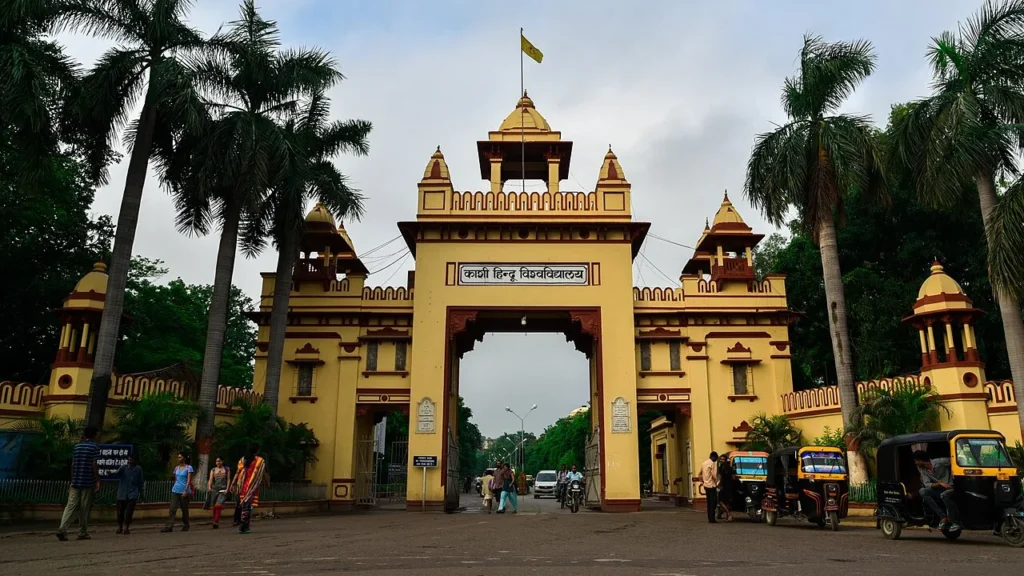
The recovery in Varanasi ran through Banaras Hindu University, founded by Madan Mohan Malaviya. The university’s own prospectus records the sequence: an Ayurveda section under the Faculty of Oriental Learning and Theology in 1920, and in 1927 the College of Ayurveda established as an independent body, running a six-year A.M.S. course with clinical training at a hundred-bed S.S. Hospital.
After that: the degree renamed A.B.M.S. in 1951; undergraduate teaching suspended in 1959 to concentrate on postgraduate work; a Post Graduate Institute of Ayurveda in 1960; merger into the newly created Institute of Medical Sciences in 1971; and BAMS restored in 1999 at four and a half years plus a year of internship. Today the Faculty lists eight departments and fifteen divisions, and BHU describes itself as the only university in India with a full-fledged constituent Faculty of Ayurveda on its campus.
A small honesty note, since we are counting years. BHU’s own documents do not perfectly agree with each other: the Faculty of Ayurveda brochure dates postgraduate Ayurveda at BHU to a Postgraduate Institute of Indian Medicine in 1963 and its conversion into the Institute of Medical Sciences in 1970. A three-year and a one-year discrepancy. Institutional memory is like that, and we would rather show you the seam than paper over it.
That same brochure carries the detail we find most useful locally: the Faculty “runs two years PG diploma courses in: Panchakarma Therapy” among others. Varanasi is not merely a city where Panchakarma is sold. It is a city where Panchakarma is examined.
The Kashi Ayurveda timeline
| Date | Event | Status |
|---|---|---|
| Undated antiquity | Dhanvantari and the churning of the ocean | Legend |
| c. 1500 to 1000 BCE (P.V. Sharma) | Divodasa teaching surgery in Kashi | Tradition, disputed |
| Last centuries BCE to c. 500 CE | Composition and redaction of the Sushruta Samhita | History, dating contested |
| c. 5th century CE | Uttaratantra added, possibly by Nagarjuna | Scholarly inference |
| 878 CE | Oldest surviving Sushruta Samhita manuscript, Kaiser Library, Nepal | History |
| 1086 to 1200 CE | Gahadavala-period layers at Rajghat, Varanasi | Archaeology |
| 1791 | Benares Sanskrit College founded; Ayurveda on the syllabus | History |
| 1822 to 1835 | Native Medical Institution founded, then abolished | History |
| 1920 and 1927 | Ayurveda section, then College of Ayurveda, at BHU | History |
| 1960 to 1971 | PG Institute, then merger into the Institute of Medical Sciences | History, dates vary by source |
| 1999 | BAMS restored at BHU | History |
| 2016 and 2023 | Padma Shri to two BHU Ayurveda figures | History |
The surgical thread, unbroken
Here is the pleasing part. The text set in Kashi is the surgical text, and Kashi is where Ayurvedic surgery came back.
Prof. Manoranjan Sahu, formerly head of the Ayurveda Faculty at BHU, spent thirty-four years working on Shalya Tantra and the Kshara Sutra method for fistula, and received the Padma Shri in 2023, reportedly the first in the field of Ayurvedic surgery. Prof. Ram Harsh Singh, a BHU graduate of 1961 and later Emeritus Professor there, received the Padma Shri in 2016 and died in Varanasi in 2023.
Two thousand years between Divodasa’s students and a Kshara Sutra clinic on the same riverbank, and the subject is still surgery. Alongside that sits the Ayurveda Network at BHU, which puts teaching material and research from the faculty into public circulation.
What we would not claim
We would not tell you Ayurveda was invented in Varanasi. The Charaka Samhita tradition sits elsewhere, and the Atreya school of internal medicine is associated with Taxila, not Kashi. We would not tell you there is an unbroken 3,000-year lineage of practitioners here, because nobody can document one. We would not tell you an ancient date proves a treatment works; that is a separate question, answered by evidence, not by age.
What Kashi can say is narrower and better. The surgical tradition of Ayurveda names this city as its classroom, this city then spent centuries copying and teaching the texts, and it is still doing so at a public university a few kilometres from where you are reading this.
Frequently asked questions
Was Ayurveda born in Varanasi?
No, and the claim is not needed. Ayurveda has several ancient centres. What Varanasi has is the Sushruta Samhita, the founding surgical text, which presents itself as the teaching of Divodasa, king of Kashi, to his student Sushruta.
Who was Divodasa Dhanvantari?
In the Ayurvedic tradition he is the king of Kashi who taught surgery to Sushruta. The scholarly view is split: Filliozat and Meulenbeld treat him as a mythic personality, while P.V. Sharma argues he was a real teacher later identified with the god Dhanvantari.
How old is the Sushruta Samhita?
Genuinely disputed. Hoernle argued for around the sixth century BCE, a 1952 National Institute of Sciences committee proposed the third to fourth centuries CE for the recension, and Meulenbeld places the text around 500 CE. The oldest surviving manuscript is dated 878 CE.
Does BHU teach Panchakarma?
Yes. The Faculty of Ayurveda at Banaras Hindu University sits within the Institute of Medical Sciences, and its own brochure states that it runs two-year postgraduate diploma courses including one in Panchakarma Therapy.
Why this history matters to a clinic in Sarnath
We practise about eight kilometres from Rajghat and around fifteen from the BHU gate, so this is not borrowed heritage for us; it is the professional environment we work in. It also sets a standard. A tradition that wrote down its dating disputes and its training requirements deserves practitioners who do not overclaim.
If you want the practical present rather than the past, our page on Panchakarma treatment in Varanasi sets out the protocol, our full therapy price list gives every current fee, and Dr. Komal Maurya explains how a first consultation runs. Students and staff on the south side of the city may prefer the clinic guide for the BHU area or the Lanka locality page. The Kshara Sutra tradition described above is covered on our piles and fistula page. For the living city rather than the archive, try the ghats guide for morning practice or our honest look at Varanasi’s winter air.
Medical disclaimer: This page is for general information and does not replace a personal consultation. Ayurvedic therapies are prescribed after individual assessment. Do not stop or change any prescribed medication on the basis of this page. If you have a medical emergency, contact a hospital immediately.
Reviewed by Dr. Komal Maurya, BAMS, Vedic Panchakarma, Sarnath, Varanasi.
Ayurveda in Kashi, practised rather than displayed
If you are in Varanasi and want to see what this tradition actually does for a joint, a gut or a sleepless month, come and ask. Consultation takes thirty to forty minutes and starts with your pulse, not a package.
Vedic Panchakarma
Old RTO Chauraha, Sarnath, Varanasi 221007
Open 9:00 AM to 8:00 PM, Mon to Sat


 Old RTO Chauraha, Sarnath, Varanasi 221007