Ask ten Banarasis which are the best ghats in Varanasi for meditation and you get ten answers, all partly right. Most of the eighty-odd ghats are hopeless for practice at dawn. About seven are genuinely good, and what separates them is boring, physical stuff: flat stone to sit on, boat touts, wet steps, noise. This is a local’s list.
Quick answer
The best ghats in Varanasi for meditation are Assi, Tulsi, Chet Singh, Kedar, Panchganga, Man Mandir and Namo Ghat. Assi has the free Subah-e-Banaras yoga session; Tulsi, Chet Singh and Panchganga stay quiet at dawn; Namo Ghat has level ground, ramps and parking.
- Arrive 45 minutes before sunrise, not at sunrise.
- Sunrise runs from roughly 5:05 am in June to about 6:20 am in late December.
- Manikarnika and Harishchandra are working cremation ghats, not practice spots.
- October to March is the comfortable season; monsoon submerges the lower steps.
- Carry your own mat. Stone is cold, damp and often slippery.
Why the hour before sunrise is the whole point
Ayurveda calls it Brahma Muhurta, the last muhurta of the night, roughly ninety minutes before sunrise. Dinacharya, the daily routine described in texts like the Ashtanga Hridayam, puts waking, oral care and breath work in exactly this window.
The reasoning is not mystical. The air is still, traffic has not started, the mind has not yet been handed a phone. Anyone who has tried both knows pranayama then lands differently from pranayama at nine.

1. Assi Ghat, for company and structure
Assi is the southernmost of the principal ghats, where the Assi stream meets the Ganga. The Varanasi district portal describes the sunrise programme of Vedic hymns, classical music, yoga sessions and prayers held here, and that programme is why Assi tops most lists.
It began on 24 November 2014 at New Assi Ghat and still runs daily and free, sustained by public contribution, according to its own organisers. Chanting, aarti, a yagya, a live morning raga, then guided yoga. Start times shift with the season, so ask locally the day before rather than trusting a blog.
Practicalities: a large flat platform, loud in a pleasant way. Not silence, but rhythm, which many people find easier to sit with. Autos from Assi Chauraha drop you at the top of the steps.
2. Tulsi Ghat, five minutes upstream and a world quieter
Walk south past the akhara and you reach Tulsi Ghat, named for the poet-saint Tulsidas, who lived here while composing the Ramcharitmanas. There is a math, a Hanuman temple and a wrestling akhara above the steps.
Almost nobody comes at dawn except wrestlers, a few regulars and the dogs. Steps are narrower and steeper than at Assi, but the broad landings take a mat comfortably. No chai stall until later. Under ten minutes on foot from Assi Chauraha.
3. Chet Singh Ghat, the widest quiet terrace on the river
This is the ghat with the fort above it, site of the 1781 stand-off between Raja Chet Singh and Warren Hastings. The district portal notes that today monks chant here and pilgrims bathe in calm water below those ramparts.
For practice it is close to ideal: long horizontal terraces, few boats calling, and the fort wall blocking the town noise behind you. In winter the sun comes up straight across the river with nothing in the way. Fifteen minutes north from Assi along the riverfront, or an auto to Shivala.
4. Kedar Ghat, if you like devotion happening around you
Kedar carries the striped red-and-white steps below the Kedareshwar temple, built in a South Indian style and much loved by Tamil and Malayali pilgrim families. The official description calls the atmosphere devotional yet relatively calm, which is exactly right.
Bells, chanting, people bathing and reciting. If your practice is japa rather than fine-grained breath work, this is a good room to sit in. The steps are steep and there are many. Avoid it during Shravan and around Mahashivratri. Nearest landmark, Sonarpura.
5. Panchganga Ghat, the scholar’s ghat
Panchganga sits far north, where tradition holds five rivers meet. The Varanasi portal records that saints and scholars often meditated here and that it stays less crowded than Dashashwamedh or Assi.
It has the deepest, most vertical flight of steps on this list, climbing to the mosque above. That climb is the filter. Tourists will not do it at five in the morning, which is precisely why it works. Not a good choice if your knees are unhappy.
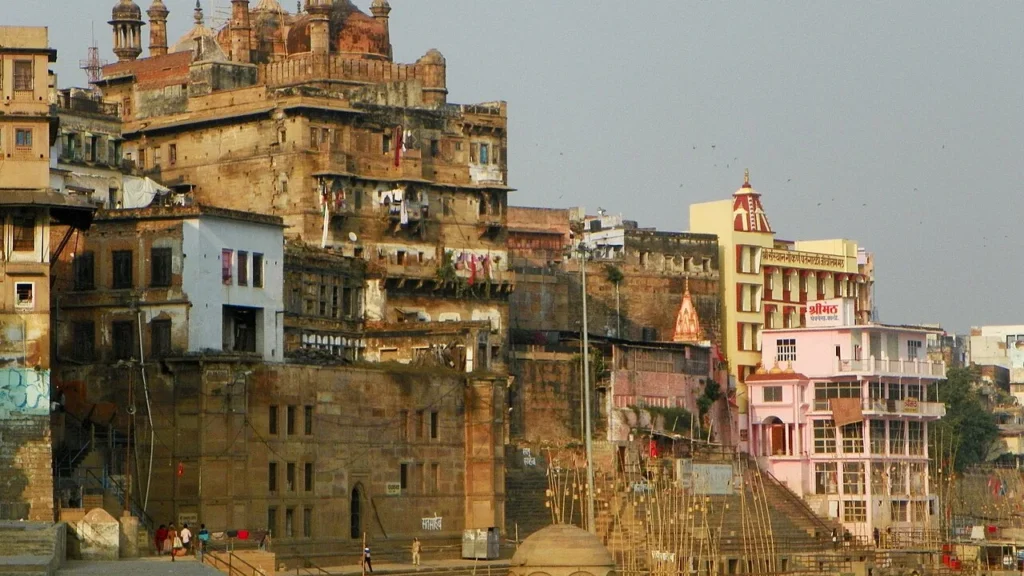
6. Man Mandir Ghat, a short sit under an observatory
Above it stands the sandstone palace of Raja Sawai Man Singh of Amber, and on its terrace the masonry instruments installed by Jai Singh II in the 1700s, including the Samrat Yantra for time and the Nadivalaya for tracking the sun. There is a pleasing logic to a sun-facing practice below a building made to measure exactly that.
Be realistic. It is close to Dashashwamedh, so by six-thirty the boats and camera phones arrive, and the flat area is small. Come early, practise thirty minutes, leave.
7. Namo Ghat, the accessible one nobody expects
Namo Ghat is the redeveloped Khidkiya Ghat at the northern end of the riverfront, the one with the giant namaste sculptures. The city’s project record lists yoga and meditation spaces, ramps for elderly and disabled visitors and vehicle parking across about 81,000 square metres.
That combination exists nowhere else on the river. Level ground, no stairs, parking, clean toilets. If you have a knee replacement, a bad back or a parent to bring along, this is the answer. It is also the closest ghat to the Sarnath side, so you can drive in off the Ring Road without going near Godowlia. Newer, so less atmospheric. That is the trade.
The ghats we are not recommending, and why
Manikarnika and Harishchandra are cremation grounds. The district portal describes cremations at Manikarnika going on around the clock, and Harishchandra runs both wood pyres and an electric crematorium. Families are burning their dead there this morning.
Rolling out a yoga mat next to that is not spiritually advanced. It is rude. If contemplating death is what draws you to Kashi, walk past quietly, do not photograph, and sit elsewhere. Skip Dashashwamedh at dawn too: busiest ghat in the city, touts start early.
The seven ghats at a glance
| Ghat | Best time | Crowd at dawn | Sitting space | Access | Suits |
|---|---|---|---|---|---|
| Assi | 45 min before sunrise | High but purposeful | Large flat platform | Easy, Assi Chauraha | Beginners, groups, visitors |
| Tulsi | 30 min before sunrise | Very low | Broad landings | Walk from Assi | Quiet solo practice |
| Chet Singh | 40 min before sunrise | Low | Wide terraces, best on the river | Riverfront walk or Shivala | Long sittings |
| Kedar | Sunrise onward | Moderate, devotional | Stepped, little flat area | Sonarpura, steep steps | Japa and chanting |
| Panchganga | 50 min before sunrise | Very low | Landings mid-flight | Long stair climb | Experienced practitioners |
| Man Mandir | Before 6:00 am | Low early, high by 6:30 | Small | Godowlia lanes on foot | Short focused practice |
| Namo Ghat | Any time before 7:00 am | Low to moderate | Very large, level | Ramps and car parking | Elderly, mobility needs, drivers |
The river-water question, answered honestly
People ask whether they can do achamana, jala neti or a dip as part of practice. A Ministry of Jal Shakti statement on monitoring of Ganga water quality reports biochemical oxygen demand of 3 to 6 mg per litre on the Mirzapur to Ghazipur stretch, which includes Varanasi. The primary bathing criterion is 3 mg per litre or less.
- Never put river water into your nose. Jala neti needs clean, salted, boiled-and-cooled water.
- Avoid bathing with open cuts, a fresh tattoo or reduced immunity, and shower afterwards.
- Wash your hands before the post-practice kachori. That is where most stomach upsets begin.
- Sit on your own mat. Damp winter stone reliably stiffens a lower back.
Seasons, and what actually goes wrong
From July to September the river swallows the lower steps everywhere on this list, and green algae makes what remains genuinely dangerous. Some ghats simply close themselves for the monsoon.
December and January bring dense fog off the water, which is also when the city’s winter air quality is at its worst. October, November, February and March are the honest best months. And it gets cold: January at five in the morning beside moving water takes a layer more than you packed.
Frequently asked questions
Which ghat is best for morning meditation in Varanasi?
Assi Ghat, because the free Subah-e-Banaras programme gives you structure, a flat platform and a crowd doing the same thing. For silence, Chet Singh and Tulsi are better, and Panchganga is quietest of all if you can manage the steps.
What time should I reach the ghats for pranayama?
Be seated about 45 minutes before sunrise, roughly 4:20 am in June and around 5:35 am in late December. That covers the Brahma Muhurta window and finishes you before the boats start.
Is the Subah-e-Banaras session at Assi Ghat free?
Yes. The organisers state it has run daily since 24 November 2014 at New Assi Ghat, sustained by public contributions. Timings shift with the season, so confirm locally the day before.
Can I meditate at Manikarnika Ghat?
Please do not. Manikarnika is an active cremation ground where families are grieving around the clock, and Harishchandra is the same. Walk past quietly and without photographs, then practise at one of the seven ghats listed here.
A closing word from us
We run an Ayurvedic day-care clinic at Old RTO Chauraha in Sarnath, about twenty minutes from Namo Ghat. When a patient arrives with a stiff neck, poor sleep or a sinus that blocks every winter, the first thing we usually change is not a medicine. It is what happens between waking and breakfast.
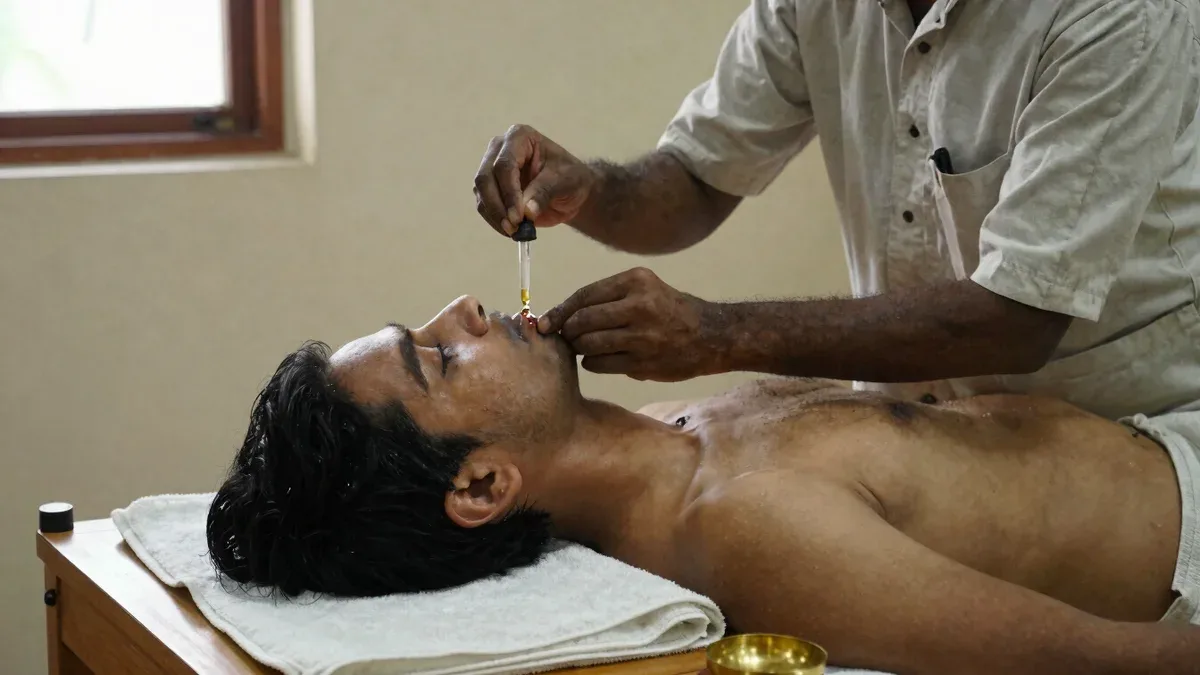
Our page on Panchakarma treatment in Varanasi sets out how Dinacharya and Ritucharya sit alongside therapy. For blocked sinuses, Nasya; for sleep and anxiety, Shirodhara. Staying near the river? The Assi Ghat area guide has the route, and there is a longer Kashi wellness week itinerary.
Medical disclaimer: This page is for general information and does not replace a personal consultation. Ayurvedic therapies are prescribed after individual assessment. Do not stop or change any prescribed medication on the basis of this page. If you have a medical emergency, contact a hospital immediately.
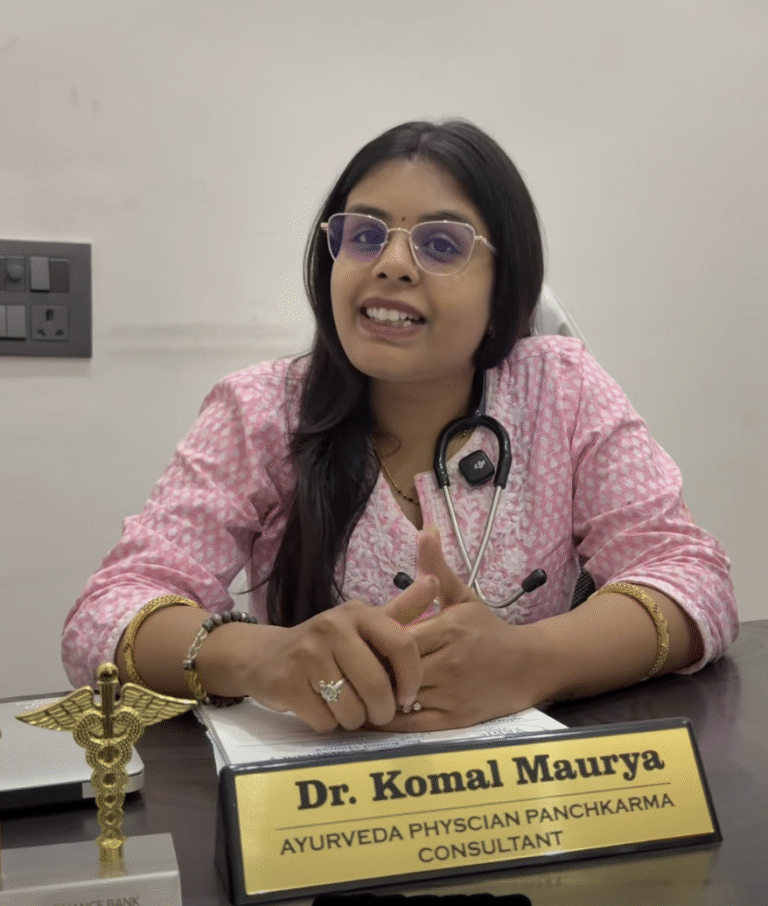
Reviewed by Dr. Komal Maurya, BAMS, Vedic Panchakarma, Sarnath, Varanasi.
Want your morning routine built properly?
A Dinacharya that fits your Prakriti and your actual working day is something we set up in the first consultation (₹500), alongside any therapy you may need; every rate is on our therapy price list.
Vedic Panchakarma
Old RTO Chauraha, Sarnath, Varanasi 221007
Open 9:00 AM to 8:00 PM, every day