
Sesame Oil (Til Tail): Ayurvedic Benefits, Uses, Dosage and Precautions
Medical & Safety Disclaimer
This content is for educational purposes only and not medical advice. Always consult a qualified physician or Ayurvedic practitioner before using sesame oil for therapeutic purposes, especially if you have known food allergies, sensitive skin, or underlying health conditions.
Sesame oil benefits have made this traditional oil a popular choice for cooking, massage, skin care, and Ayurvedic routines. Known as Tila Taila in Ayurveda, sesame oil has been used for generations in Abhyanga and as a base for herbal oil formulations. It also provides unsaturated fats and naturally occurring plant compounds such as sesamin and sesamol, which have attracted scientific interest.
But how much of what you hear online is actually supported by evidence? The answer isn’t always straightforward. Some sesame oil benefits are linked to its nutritional profile or traditional use, while claims about hormones, hair growth, bone health, or specific diseases need more caution.
In this guide, I’ll break down the practical sesame oil uses, Ayurvedic applications, appropriate sesame oil dosage, possible sesame oil side effects, and important precautions so you can decide where this oil fits into your everyday routine.
✓
Panchakarma in Monsoon at a Glance
6 Key Insights
01
02
03
04
05
06
What Is Sesame Oil?
Sesame oil is made from the seeds of Sesamum indicum, a plant cultivated and used across Asia and other parts of the world. In India, it is commonly known as “til oil” or “til ka tel.”
The oil has two identities worth separating. In the kitchen, it is a flavorful edible oil. In Ayurveda, sesame oil is known as Tila Taila and has a long history in external oil therapies and herbal formulations.
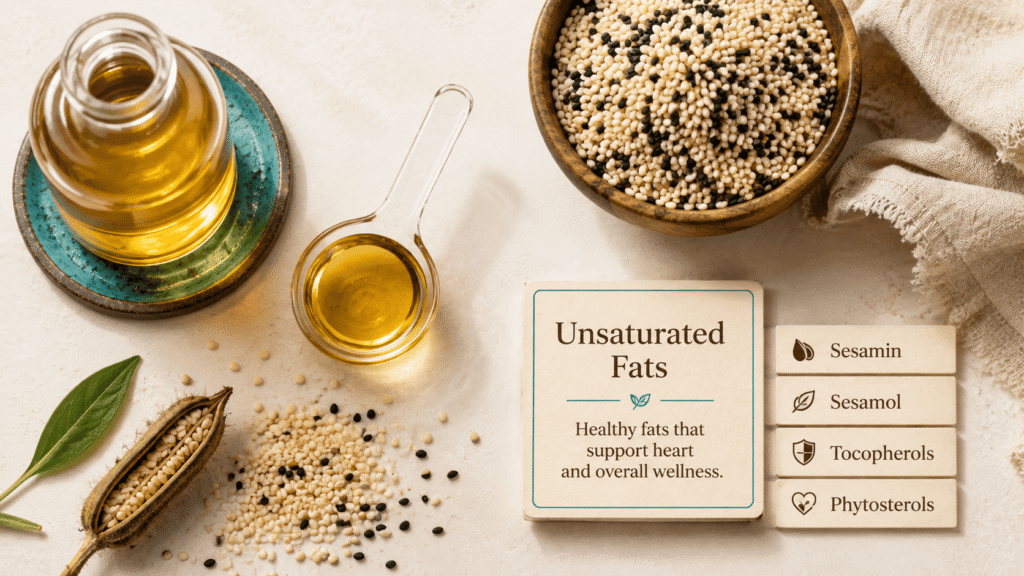
The nutritional profile helps explain some of the interest around sesame oil benefits. Sesame oil contains predominantly unsaturated fats along with naturally occurring compounds such as sesamin, sesamol, tocopherols, and phytosterols.
For everyday use, I’d keep the approach practical. Sesame oil can be a useful ingredient, but more oil isn’t automatically better. The purpose, quantity, and quality of the preparation all matter.
Sesame Oil Nutrition and Key Compounds
Sesame oil’s nutritional profile helps explain some of the interest around sesame oil benefits. It provides mostly unsaturated fats, as verified by the USDA FoodData Central database, along with naturally occurring compounds such as sesamin, sesamol, tocopherols, and phytosterols. The table below gives you a quick look at what you’re getting from this traditional oil.
| Nutritional feature | What it means |
|---|---|
| Main fat type | Predominantly unsaturated fats |
| Energy | About 120 calories per tablespoon |
| Notable compounds | Sesamin, sesamol, tocopherols and phytosterols |
| Flavor | Mild to distinctly nutty |
| Common forms | Regular, toasted and cold-pressed varieties |
Sesame Oil in Ayurveda

Sesame oil benefits in Ayurveda are closely associated with tila taila. Traditional Ayurvedic practice uses sesame oil for Snehana, or oleation, and it is widely associated with Abhyanga, the practice of oil massage.
Ayurvedic tradition describes sesame oil as warming and nourishing and commonly connects it with Vata-oriented routines. These are traditional concepts and should not be presented as modern clinical findings.
Tila Taila also serves as a base for many Ayurvedic oil preparations. Herbs can be processed with the oil to produce formulations intended for particular traditional applications.
🌿 Seasonal Ayurvedic Wisdom
Planning your warm oil therapy during seasonal shifts?
Learn why traditional oil massages like Abhyanga are especially powerful during monsoon in our detailed guide:
Read the Seasonal Guide →
Why sesame oil is used in Ayurvedic formulations
Plain sesame oil and a medicated Ayurvedic oil aren’t necessarily interchangeable.
| Plain sesame oil | Ayurvedic medicated oil |
|---|---|
| Primarily an edible or topical oil | Prepared for a specific traditional purpose |
| Usually contains sesame oil alone | May contain multiple herbs and ingredients |
| Used for cooking or basic oiling | Used according to formulation-specific directions |
| Quantity depends on everyday use | Dosage and application may require practitioner guidance |
This distinction becomes especially important when someone searches for sesame oil benefits and then assumes every sesame-based product works in exactly the same way.
For an Ayurvedic formulation, the complete ingredient list, preparation method, and intended use deserve attention.
9 Sesame Oil Benefits You Should Know
The most useful sesame oil benefits relate to its nutritional profile, naturally occurring plant compounds, culinary applications, and traditional topical use. Research has also examined sesame oil in metabolic and cardiovascular settings, although the evidence does not make it a substitute for medical treatment.
1. Sesame oil benefits include unsaturated fats
One tablespoon of sesame oil provides roughly 120 calories and about 14 grams of fat. Most of that fat is unsaturated.
Replacing some foods higher in saturated fat with sources of unsaturated fat can fit into a heart-conscious eating pattern.
A practical point: Measure the oil when you’re cooking. Pouring directly from the bottle can turn a teaspoon into a tablespoon surprisingly fast.
2. Sesame oil benefits include antioxidant compounds
Sesame oil contains plant compounds such as sesamin and sesamol, along with tocopherols and phytosterols.
These compounds have antioxidant activity and have attracted scientific interest. Laboratory findings, though, aren’t enough to say that sesame oil prevents or cures a particular disease.
The useful takeaway is narrower. Sesame oil provides naturally occurring compounds that contribute to its nutritional profile.
🌱 Complementary Herbal Care
Looking to pair healthy fats with powerful adaptogenic herbs?
Explore how Holy Basil supports daily wellness and vitality alongside traditional oils:
3. Sesame oil benefits may include metabolic support
Researchers have examined sesame oil in relation to blood glucose and blood pressure markers in several clinical trials.
Some clinical reviews have reported favorable changes in selected metabolic measures, but the number and quality of studies remain limited.
So it makes sense to view sesame oil as a dietary option, not a treatment.
- It doesn’t replace diabetes medication.
- It doesn’t replace blood pressure treatment.
- It shouldn’t be used as a substitute for dietary changes recommended by your clinician.
- Portion size still matters.
4. Sesame oil benefits for cooking include flavor and versatility
Sesame oil benefits for cooking go beyond its nutrient profile. Its nutty taste works particularly well in Indian, Asian, and fusion recipes.
There is an important difference between regular and toasted sesame oil.
| Type | Flavor | Common use |
|---|---|---|
| Regular sesame oil | Mild, nutty | Cooking and sautéing |
| Toasted sesame oil | Strong, roasted | Sauces, noodles and finishing |
| Cold-pressed sesame oil | Distinctive, relatively mild | Culinary and traditional applications |
Toasted sesame oil is usually used in smaller quantities because the flavor is intense.
A teaspoon can be enough to change the character of a dish. You don’t need half the bottle.
🍲 Ayurvedic Culinary Wellness
Want to boost digestive fire alongside culinary oils?
Discover how ginger works in classic cooking and internal remedies in our complete guide:
5. Sesame oil benefits for massage are rooted in Ayurveda
Sesame oil benefits for massage are particularly well established within traditional Ayurvedic practice.
Warm sesame oil is commonly used for abhyanga, where oil is massaged over the body before bathing. Ayurvedic routines traditionally associate sesame oil with warming and nourishing qualities.
For a simple home massage:
- Warm a small amount of oil gently.
- Check the temperature on your wrist first.
- Massage using comfortable pressure.
- Leave the oil on for a suitable period.
- Bathe afterward if that fits your routine.
Avoid very hot oil. A relaxing massage shouldn’t end with a skin burn.
6. Sesame oil benefits for skin may include better moisture retention
Sesame oil has an emollient quality, which means it can help soften skin that feels dry or tight.
This is one of the more straightforward sesame oil benefits for skin because the oil creates a layer over the skin rather than needing a complicated mechanism. Try a small patch first, especially if your skin is reactive.
Don’t apply it casually to the following:
- Open wounds
- Infected skin
- Severe rashes
- Areas that become irritated after application
A known sesame allergy requires much greater caution.
7. Sesame oil benefits for hair are mainly about conditioning
Sesame oil benefits for hair are often discussed in traditional hair-oiling practices. The oil can coat dry-feeling hair and make it feel softer and easier to manage.
Ayurvedic hair routines may use sesame oil alone or as the base for herbal preparations.
The evidence is much weaker for claims that sesame oil regrows lost hair, reverses baldness, or reliably stops premature graying.
So think conditioning, not a guaranteed hair-growth treatment.
8. Sesame oil benefits include useful plant compounds
Beyond its fatty acids, sesame oil contains naturally occurring lignans and other bioactive compounds.
Sesamin is one of the compounds most often discussed in sesame research. Sesamol and tocopherols have also received scientific attention because of their antioxidant properties.
These compounds add nutritional interest, but they don’t turn sesame oil into a supplement that needs to be consumed in large quantities.
A balanced diet still matters more than any single ingredient.
9. Sesame oil benefits extend to traditional formulations
One of the less discussed sesame oil benefits is its role as a base oil in Ayurvedic preparations.
Practitioners may process herbs with sesame oil to produce specialized oils. The final formulation can have a very different traditional purpose from plain cooking oil.
That distinction is useful when reading labels. A product containing sesame oil isn’t automatically equivalent to another product containing sesame oil.
Sesame Oil Uses for Cooking, Massage, Skin and Hair

The best sesame oil uses depend on what you’re trying to do.
| Sesame oil use | Practical application | Key point |
|---|---|---|
| Cooking | Sautéing and everyday recipes | Measure portions |
| Finishing | Sauces, noodles and dressings | Toasted oil has a strong taste |
| Massage | Abhyanga and personal massage | Warm gently |
| Skin care | Dry-feeling skin | Patch-test first |
| Hair care | Pre-wash scalp and hair oiling | Mainly conditioning |
| Ayurvedic formulations | Base for medicated oils | Follow formulation directions |
| Traditional navel use | Cosmetic or traditional practice | Special systemic benefits aren’t established |
Sesame oil benefits for belly button use
Putting sesame oil into the navel is promoted in some traditional and wellness practices. Claims about improving digestion, hormones, and internal organs, however, aren’t supported by good clinical evidence.
You can treat it as a traditional personal-care practice if you choose, but it shouldn’t be presented as a proven route for delivering sesame oil benefits throughout the body.
Sesame Oil Dosage: How Much Should You Use?
There isn’t one universal sesame oil dosage.
The appropriate amount changes depending on whether you’re cooking with it, applying it to the skin, oiling your hair, or using a therapeutic Ayurvedic formulation.
| Purpose | Practical approach |
|---|---|
| Cooking | Use a measured amount suited to the recipe |
| Salad or finishing | Start with a small amount |
| Massage | Enough to cover the skin comfortably |
| Hair oiling | Enough to lightly coat the scalp and hair |
| Ayurvedic external therapy | Follow practitioner instructions |
| Therapeutic internal use | Don’t self-prescribe a dose |
A tablespoon contains around 120 calories, so using several tablespoons every day can add a substantial amount of energy.
For this reason, the best sesame oil dosage for everyday food use is usually a reasonable culinary portion, not a large spoonful taken as a health remedy.
For therapeutic use, the sesame oil dosage should come from the specific preparation and qualified practitioner guidance.
Sesame Oil Side Effects and Precautions
Most people can use sesame oil without problems, but sesame allergy is the major safety concern.
Sesame is recognized as a major food allergen in the United States. Reactions can range from skin symptoms to serious breathing problems.
Potential signs of an allergic reaction include:
- Hives or itching
- Swelling
- Stomach discomfort
- Wheezing
- Difficulty breathing
- Severe allergic reaction
People with a diagnosed sesame allergy should avoid sesame-containing products unless their allergy specialist gives specific advice.
Other sesame oil side effects and precautions
Beyond sesame allergy, a few everyday precautions are worth keeping in mind. Your skin sensitivity, health conditions, intended use, and the type of Ayurvedic preparation can all affect whether sesame oil is appropriate for you.
| Situation | Sensible precaution |
|---|---|
| Sesame allergy | Avoid sesame oil |
| Sensitive skin | Patch-test before wider use |
| Irritated skin | Stop if burning or itching develops |
| Open wounds | Don’t apply without professional guidance |
| Calorie-controlled diet | Measure culinary portions |
| Pregnancy or breastfeeding | Seek professional advice before therapeutic use |
| Chronic disease | Discuss concentrated use with your clinician |
| Ayurvedic treatment | Follow qualified practitioner guidance |
One important distinction is worth remembering. Sesame oil side effects from an allergy are very different from ordinary digestive or topical intolerance. A suspected allergic reaction deserves prompt medical attention.
Sesame Oil vs Olive Oil
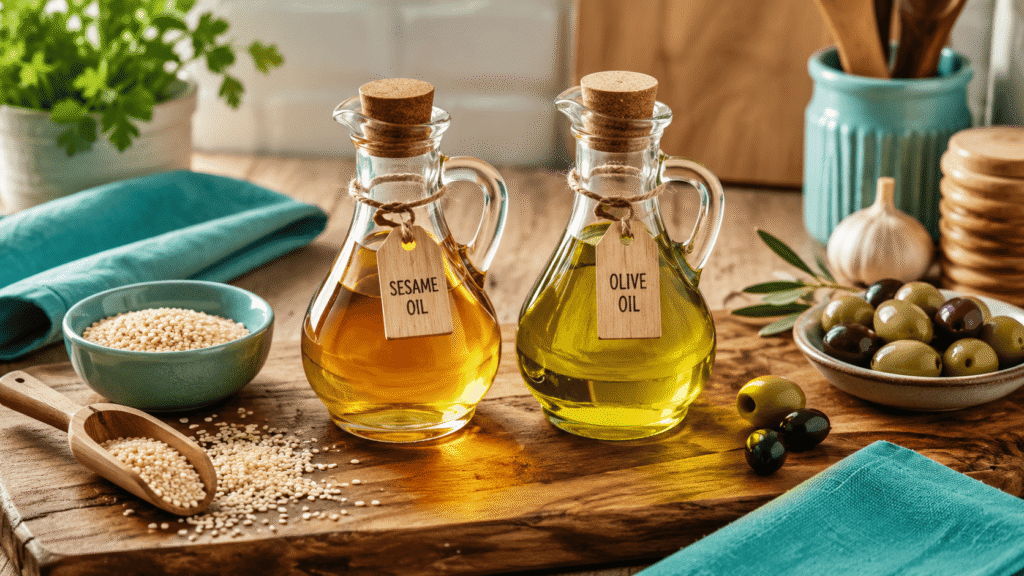
People often ask whether sesame oil is better than olive oil. There isn’t a universal winner.
Both oils can fit into a balanced eating pattern, but they have different flavors, culinary roles and traditional uses.
| Feature | Sesame oil | Olive oil |
|---|---|---|
| Flavor | Nutty | Mild to fruity |
| Notable compounds | Sesamin, sesamol and tocopherols | Polyphenols and vitamin E |
| Traditional Ayurvedic role | Strong | Less central |
| Common culinary use | Indian and Asian cooking | Mediterranean-style cooking |
| Massage use | Common in Ayurveda | Also used topically |
| Best choice | Depends on the dish and purpose | Depends on the dish and purpose |
For cooking, choose the oil that suits the recipe and your overall dietary pattern rather than trying to crown one oil the healthiest.
Sesame Oil Benefits for Different Health Goals
Searches for sesame oil benefits for female health, male health, and bones often produce claims that go much further than the evidence.
A better way to read those claims is to separate established nutritional value, traditional use, and unproven therapeutic claims.
| Health goal | What sesame oil may offer | Evidence position |
|---|---|---|
| Heart-conscious eating | Unsaturated fats | Nutritionally useful |
| Metabolic health | Studied for glucose and blood pressure markers | Promising but limited |
| Skin care | Emollient properties | Practical topical use |
| Hair care | Conditioning | Traditional use, limited clinical evidence |
| Female health | Dietary fat and plant compounds | Specific hormone claims remain unproven |
| Male health | Dietary fat and plant compounds | Testosterone claims remain unproven |
| Bone health | Nutritional fats | No strong evidence that sesame oil alone improves bones |
| Muscle comfort | Massage oil in traditional practice | Not a treatment for unexplained pain |
Sesame oil benefits for female health
Sesame oil provides dietary fats and plant compounds, but it shouldn’t be promoted as a proven hormone-balancing treatment.
Claims involving menstrual disorders, fertility, or reproductive hormones need stronger clinical evidence before they can be considered established.
Sesame oil benefits for male health
The same caution applies to testosterone and fertility claims. Sesame oil can be part of a balanced diet, but evidence doesn’t support using it as a reliable testosterone booster.
Sesame oil benefits for bones
Some online articles associate sesame with bone health, but evidence for sesame oil alone improving bone density or preventing osteoporosis is not strong.
Bone health depends on a much broader picture that includes adequate calcium, vitamin D, protein, physical activity, and other factors.
Is Sesame Oil Good for Leg Pain?
Sesame oil benefits for massage may make the oil useful in a relaxing self-massage routine, particularly when ordinary muscle tightness and dry skin occur together.
Ayurvedic massage traditionally uses warm sesame oil, especially in Vata-focused routines.
Massage is not an appropriate substitute for medical evaluation when leg pain is persistent or unusual.
Seek medical care for pain accompanied by the following:
- Significant swelling
- Redness or warmth
- Numbness or weakness
- Severe tenderness
- Recent serious injury
- Unexplained or worsening symptoms
Conclusion
The most useful sesame oil benefits come from a combination of nutritional value, culinary versatility, and long-standing Ayurvedic use. Sesame oil supplies unsaturated fats and naturally occurring compounds such as sesamin and sesamol, while research continues to examine its possible metabolic effects.
The traditional side deserves equal care. Tila Taila has an established place in Ayurvedic oil practices and formulations, but a plain sesame oil bottle isn’t automatically equivalent to a medicated Ayurvedic preparation.
Use the oil according to its purpose. Keep food portions sensible, don’t self-prescribe therapeutic doses, and take sesame allergy seriously.
If you’re considering sesame-based Ayurvedic care, the formulation itself matters as much as the base oil.
 |
Ready to take the next step?At Vedic Panchakarma, we believe true healing begins by restoring balance within the body, mind, and spirit, naturally and holistically. Body • Mind • Spirit |
|
📍 Location: SA 6/168 Old RTO Office Chauraha, Sarnath, Ganapati Nagar, Ashapur Road, Pahariya, Sarnath-221007, Uttar Pradesh 📞 Contact: +91 96822 22121 ✉️ Website: vedicpanchakarma.com 🕒 Hours: Open 24 Hours |
Frequently Asked Questions
Does sesame oil need to be heated before massage?
No. Sesame oil can be used without heating. Ayurvedic massage traditions often warm the oil because warmth can make application more comfortable, but the oil should never be hot enough to burn the skin.
Is black sesame oil different from regular sesame oil?
Yes. Black sesame refers to the seed variety, while regular sesame oil can be produced from other sesame varieties. Color, flavor, and processing can differ between products.
Can sesame oil be mixed with another carrier oil?
It can be blended for some topical applications. The suitability depends on the purpose, skin sensitivity, and formulation. Ayurvedic medicated oils should generally be used according to their specific directions rather than mixed casually.
Does cold-pressed sesame oil have to be used for health benefits?
No. Cold-pressed oil is one processing method, not a requirement for obtaining the nutritional value of sesame oil. Processing can affect flavor, stability, and some naturally occurring compounds.
How should sesame oil be stored after opening?
Keep edible sesame oil tightly sealed in a cool, dark place away from heat and direct sunlight. If it develops a stale or rancid smell, discard it.
Can children use sesame oil for massage?
Children have different skin and safety needs from adults. Parents should get age-appropriate guidance before starting regular sesame oil massage, particularly for infants or children with sensitive skin.
Is toasted sesame oil suitable for Ayurvedic massage?
Toasted sesame oil is mainly a culinary product with a strong roasted flavor. A plain sesame oil intended for topical use is generally more practical for massage unless a specific Ayurvedic formulation calls for toasted oil.
Can sesame oil be used before swimming?
A small amount may help reduce the dry feeling associated with exposure to chlorinated or salt water. It does not replace sunscreen or other sun protection, and heavily coating the skin before swimming can make the surface slippery.


 Old RTO Chauraha, Sarnath, Varanasi 221007