You reach for something on a high shelf and the shoulder simply stops. It aches at night, you cannot lie on that side, and doing up a blouse or tucking in a shirt becomes a task. This is frozen shoulder, and it can last many months.
Frozen shoulder Ayurvedic treatment treats the condition as Avabahuka, a Vata disorder of the shoulder joint with Kapha adding stiffness. Care usually combines local oil therapy (Snehana), herbal heat such as Patra Pinda Pottali, Nasya, a warm Vata-calming diet and daily gentle exercises. It does not work overnight. Done steadily over weeks, alongside your doctor’s advice, it aims to ease night pain and give back movement.
What is frozen shoulder (Avabahuka)?
Frozen shoulder, or adhesive capsulitis, is a painful stiffening of the shoulder joint capsule. Both the movement you make yourself and the movement someone else makes for you become limited. In Ayurveda it closely matches Avabahuka, where aggravated Vata dries and tightens the shoulder (Amsa Sandhi) and Kapha blocks the channels.
It mostly affects people in their 40s to 60s, and women more often than men, according to a 2013 review in the Open Orthopaedics Journal. The NHS lists two main symptoms: shoulder pain that is often worse at night, and stiffness that makes the shoulder hard to move.
Classical texts also describe Amsashosha, an earlier, drier stage where the muscles around the shoulder lose nourishment. When pain and stiffness lock the arm, the picture is called Avabahuka. This difference matters, because a dry Vata shoulder and a heavy Kapha shoulder do not need the same first step.
The three stages and how long each lasts
Frozen shoulder usually moves through three stages: freezing (painful), frozen (stiff) and thawing (recovering). A 2013 review gives roughly 3 months for freezing, 3 to 9 months for frozen and 9 to 18 months for thawing. Some people improve faster, and some still have symptoms years later.
| Stage | What you feel | Ayurvedic focus | Exercise focus |
|---|---|---|---|
| Freezing (about 3 months) | Sharp pain, worse at night; movement slowly lost | Calm pain and inflammation; gentle oil, mild heat; check for Ama first | Pain-free pendulum swings only |
| Frozen (3 to 9 months) | Less pain, but the arm will not lift or turn | Regular Snehana, Patra Pinda Pottali, Nadi Swedan, Nasya | Daily stretches to the edge of comfort |
| Thawing (9 to 18 months) | Movement slowly returns | Strengthening Vata care, diet and home oiling | Longer holds and light strengthening |
Researchers now debate how neatly people follow these stages. Use them as a rough map, not a timetable.
Who gets frozen shoulder, and why diabetes matters
Diabetes is the biggest known risk factor. A 2016 meta-analysis in the Muscles, Ligaments and Tendons Journal found frozen shoulder in 13.4% of people with diabetes, about five times the risk of people without it. Shoulder injury or surgery that keeps the arm still is another common trigger.
The same analysis found that about 30% of people with frozen shoulder had diabetes. Its authors suggest checking blood sugar in anyone who presents with frozen shoulder. If you have not had a sugar test recently, bring one to your consultation or ask your physician for an HbA1c.
How Ayurveda reads a frozen shoulder
Ayurveda looks at which dosha is driving the shoulder, because that decides the first therapy. A dry, cracking, painful shoulder points to Vata. A heavy, swollen, stiff shoulder with sluggish digestion points to Kapha and Ama. Burning pain points to Pitta.
This is why the same oil massage can help one person and not another. If Ama (undigested residue) is present, the doctor usually corrects digestion before starting heavy oiling. Our page on joint pain and arthritis treatment in Varanasi explains the same rule for knees and backs.
Ayurvedic therapies used for frozen shoulder
The main therapies are local oil massage (Snehana), herbal heat (Patra Pinda Pottali and Nadi Swedan) and Nasya. Classical texts on Avabahuka name Nasya and Snehana among the key treatments. The doctor picks and orders them after assessing your dosha, stage and digestion.
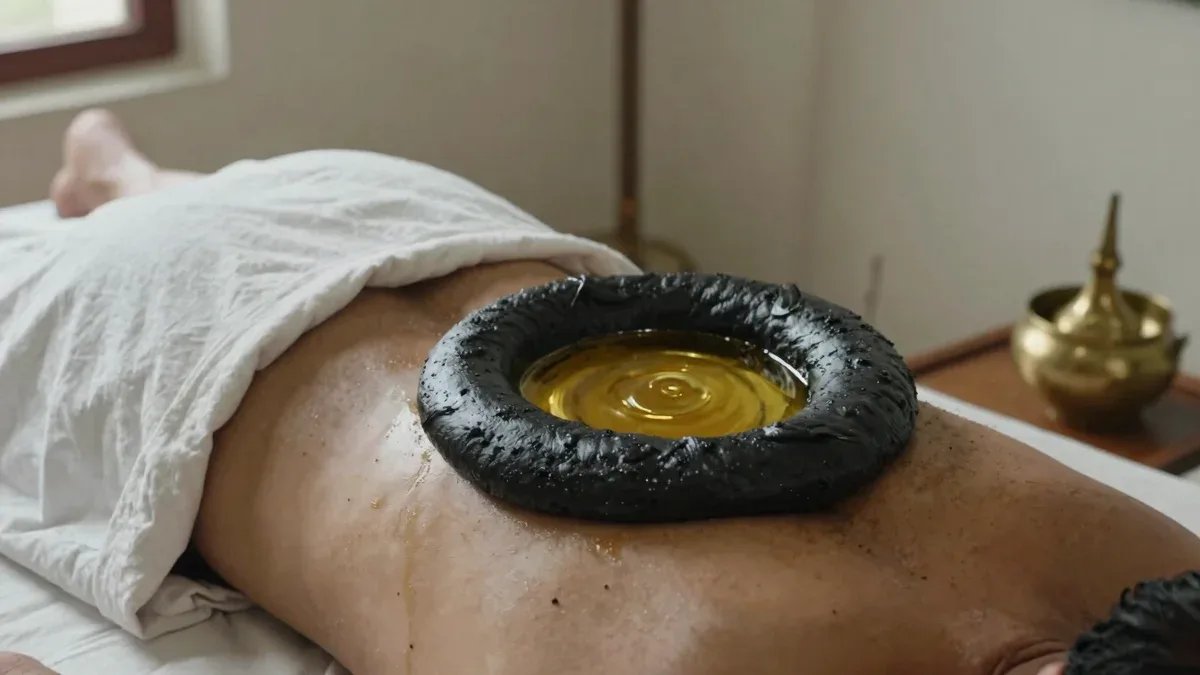
Snehana: local warm oil massage
Warm medicated oil is worked into the shoulder, the shoulder blade, the upper arm and the neck. It softens tight tissue and calms Vata. Sesame-based oils are the usual base.
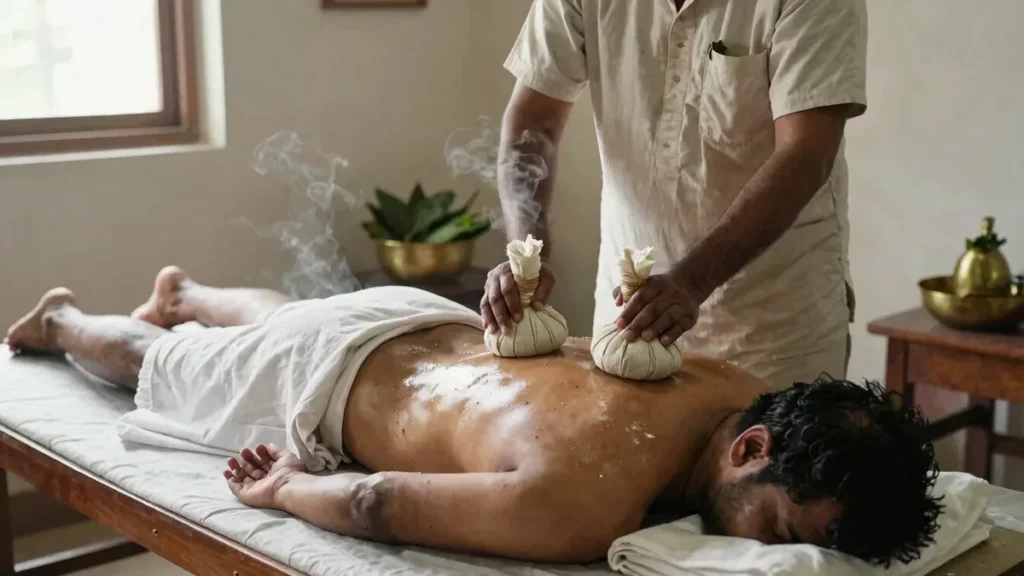
Patra Pinda Pottali Sweda
Fresh herbal leaves are tied in cloth boluses, warmed in oil and pressed and rolled over the shoulder. The moist heat eases muscle guarding, which is the protective tightening that adds to stiffness. At our clinic it costs ₹200 a session.
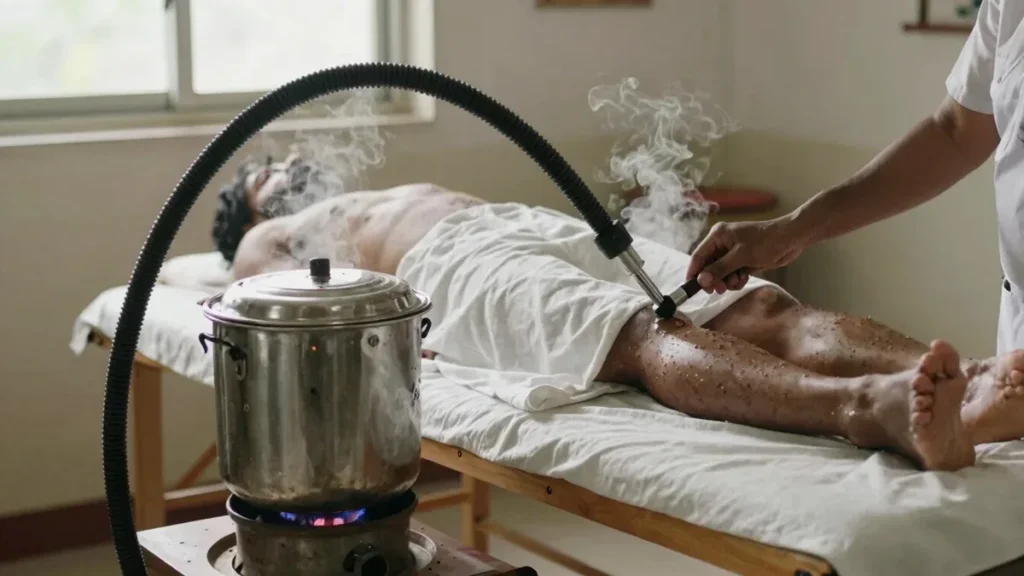
Nadi Swedan: localised herbal steam
A gentle jet of herbal steam is moved over the shoulder after oiling. It opens the channels so the oil can work, and it often makes the stretching that follows less painful.
Nasya: medicated nasal drops
Nasya is given after a face massage and steam. Classical texts link the nose to the region above the collarbones, and many Ayurvedic studies on Avabahuka use Nasya as a core therapy. See our Nasya treatment page for how a session runs.
Greeva Basti and Basti, when needed
If the neck is also stiff or pain spreads from the neck into the shoulder, the doctor may add Greeva Basti, where warm oil is held over the back of the neck. For long-standing Vata, a medicated enema course may be advised. Our Basti therapy page explains both types.
Internal medicines and diet
Classical formulations may be prescribed after your consultation, with the price told to you first. Diet stays warm and simple: moong dal, cooked vegetables, soft rotis with a little ghee, ginger and tulsi tea. Cut down on cold drinks, curd at night, fried snacks and late dinners.
What does the research say?
The Ayurvedic evidence for frozen shoulder is encouraging but small. Most published work is case reports and trials of 30 or fewer patients. No large trial has yet proven that one Ayurvedic protocol works better than standard care, so treat any promise of a quick cure with caution.
One example: a 2024 study in the International Ayurvedic Medical Journal compared 15 patients given Masha Taila (as Matra Basti and local oiling) plus physiotherapy with 15 given physiotherapy alone. Marked improvement was seen in 11 of 15 (73%) in the combined group, against 2 of 15 (13%) with physiotherapy alone. It was one small study, but it supports using Ayurveda alongside exercise, not instead of it.
Modern care has limits too. The 2013 review notes that steroid injections help mainly in the short term, and that gentle care often works better than aggressive physiotherapy. That is the same pace Ayurveda prefers.
| Option | What it does well | Limits |
|---|---|---|
| Painkillers (paracetamol, ibuprofen) | Quick pain relief to allow movement | Do not restore movement; side effects with long use |
| Steroid injection | Strong short-term pain relief, mostly early on | Benefit fades over months; can raise blood sugar |
| Physiotherapy and home exercises | Main route to regaining movement | Needs weeks of daily effort; aggressive stretching can flare pain |
| Ayurvedic therapy (Snehana, Pottali, Nasya, diet) | Eases stiffness and night pain, supports exercise, addresses digestion and Vata | Small evidence base; needs a course, not one session |
| Surgery or manipulation under anaesthesia | For stubborn cases after months of other care | Invasive; recovery time |
Frozen shoulder exercises you can do at home
Gentle daily movement is the single most useful thing you can do. The NHS recommends gentle exercises and a heat pack for up to 20 minutes at a time. Work to mild stretch, never sharp pain, and do the exercises after warm oil or a warm bath when the shoulder is loose.
- Pendulum swing. Lean forward with your good hand on a table. Let the sore arm hang and draw small circles, 10 each way. Good in the painful stage.
- Wall finger walk. Face a wall at arm’s length. Walk your fingers up the wall as high as is comfortable, hold 10 seconds and walk down. Repeat 5 to 10 times.
- Towel stretch. Hold a towel behind your back with both hands, the good arm on top. Gently pull upwards to raise the sore arm. Hold 10 seconds, 5 times.
- Cross-body reach. Use the good arm to lift the sore arm at the elbow and bring it across your chest. Hold 15 seconds, 5 times.
- Outward rotation with a stick. Lie on your back, elbows at your sides, holding a stick. Push the sore hand outward with the good one. Hold 10 seconds, 5 times.
Add simple Pranayama such as Anulom Vilom to calm the pain-tension cycle; our Pranayama page explains how we teach it. If any exercise causes pain that lasts more than an hour afterwards, ease off and ask your doctor or physiotherapist.
How treatment works at our Sarnath clinic
Every plan starts with a ₹500 consultation with Nadi Pariksha. The doctor checks shoulder movement, your dosha, digestion and sugar status, then writes the therapies, number of sittings and total cost before anything begins. We are a day-care clinic, so you go home after each session.
- Consultation (₹500). Pulse reading, history, movement check and a look at any X-ray, sugar or thyroid reports you bring.
- Written plan. Which therapies, in what order, for how many days, and the exact cost.
- Daily sittings. Usually Snehana, then Patra Pinda Pottali and Nadi Swedan, with Nasya or Greeva Basti if advised.
- Home routine. Exercises, diet and how to oil the shoulder at home.
- Review. The doctor checks your range of movement and adjusts the plan.
When pain spreads from the neck into the shoulder, the closest ready-made course is our Cervical (Neck) Care Programme: 7 sittings of Greeva Basti, neck-and-shoulder Snehan, Patra Pinda Swed and Nadi Swed for ₹9,500, or ₹1,600 per day if you pay day-wise. For a shoulder-only problem, the doctor may build a plan from single therapies instead.
| Service at Vedic Panchakarma, Sarnath | Rate |
|---|---|
| First consultation with Nadi Pariksha | ₹500 |
| Patra Pinda Pottali Swed | ₹200 |
| Nadi Swedan (localised steam) | ₹200 |
| Nasya | ₹300 |
| Greeva Basti | ₹800 per sitting |
| Snehan (Abhyanga), full body | ₹1,000 |
| Cervical (Neck) Care Programme, 7 days | ₹9,500 (or ₹1,600 per day) |
See the full therapy price list, or read about Dr. Komal Maurya and how consultations work. Oral medicines, if prescribed, are priced separately and told to you first.
Patients often tell us what they value most is being listened to. “She listens to every concern patiently and explains everything clearly,” wrote Shreya S. in a Google review. Another patient, Avanish Y., came for a spine problem and wrote that the “staff behaviour was great.” Our clinic holds a 4.9 rating from 74 Google reviews.
When to see a doctor first
Some shoulder pain is not frozen shoulder, and some needs urgent care. Left shoulder or arm pain with chest tightness, breathlessness or sweating can be a heart attack: go to a hospital at once. Fever with a hot, swollen shoulder needs same-day medical care.
See an orthopaedic doctor before starting therapy if you had a fall or injury, if the shoulder looks deformed, if the arm is suddenly weak or numb, or if you have unexplained weight loss or a history of cancer. In true frozen shoulder, movement is blocked even when someone else lifts your arm. If others can lift it easily but you cannot, a rotator cuff problem is more likely and needs a different plan.
Frequently asked questions
Can frozen shoulder be cured with Ayurveda?
Ayurveda can ease pain and stiffness and support recovery, but it is not an instant cure. Most people need a course of therapy over several weeks, plus daily exercises at home. Results depend on the stage, your age, blood sugar control and how regularly you move the shoulder.
What is the best Ayurvedic oil for frozen shoulder?
There is no single best oil. Sesame-based Vata oils such as Mahanarayan or Masha Taila are commonly used, but the right one depends on whether your shoulder is dry and Vata-type or heavy and Kapha-type. Ask an Ayurvedic doctor before using heavy oils if the joint feels swollen or your digestion is weak.
How long does frozen shoulder take to heal?
Frozen shoulder often takes one to two years to settle fully, moving through freezing, frozen and thawing stages. Some people recover faster and a few keep mild stiffness for longer. Regular exercise, good sugar control and timely therapy can make the painful months easier to manage.
Is Patra Pinda Pottali good for shoulder pain?
Patra Pinda Pottali uses warm herbal leaf boluses to relax muscle guarding and ease stiffness, so it is a common choice for frozen shoulder and other Vata joint pain. It is usually given after oil massage. People with fever, skin infection over the shoulder or a very inflamed joint should wait.
Should I massage a frozen shoulder?
Gentle warm oil massage usually helps a stiff Vata-type shoulder, especially before stretching. Avoid deep, forceful massage in the very painful early stage, and do not massage a hot, swollen joint. If the shoulder hurts more for hours after massage, stop and get it checked by a doctor.
Why do people with diabetes get frozen shoulder?
The exact reason is not fully known, but high blood sugar seems to stiffen the tissue of the joint capsule. A 2016 meta-analysis found people with diabetes are about five times more likely to develop frozen shoulder. Keeping sugar under control is an important part of recovery.
Can I continue my allopathic medicines during Ayurvedic treatment?
Yes. Keep taking medicines your doctor has prescribed, especially for diabetes, thyroid or blood pressure. Bring the list to your consultation so the Ayurvedic plan can be made safely around them. Do not stop or change any prescribed medicine without talking to the doctor who prescribed it.
The bottom line
Frozen shoulder is slow, but it usually does improve. Ayurvedic treatment for Avabahuka uses warm oil, herbal heat, Nasya and a Vata-calming routine to ease night pain and help the shoulder move again, while you keep up daily exercises. Start with a proper assessment, check your blood sugar, and give the plan a few steady weeks. For more on the wider picture, read our Hindi guide to जोड़ों के दर्द का आयुर्वेदिक इलाज.
Talk to us before you book
Call or WhatsApp us, every day 9 AM to 8 PM. Tell us your concern and we will suggest the right therapy or package and the cost before you visit.
Book on WhatsAppConsultation ₹500 with Nadi Pariksha · Open daily 9 AM to 8 PM
This article is general information and not a substitute for a personal medical consultation. Ayurvedic therapies are prescribed after individual assessment. Do not stop prescribed medicines on the basis of this page. Shoulder pain with chest pain, breathlessness or sweating, fever with a hot swollen joint, or sudden arm weakness needs urgent hospital care.
Sources
- NHS, Frozen shoulder (accessed 2026)
- Zreik NH, Malik RA, Charalambous CP. Adhesive capsulitis of the shoulder and diabetes: a meta-analysis of prevalence. Muscles, Ligaments and Tendons Journal (2016)
- Nagy MT et al. The Frozen Shoulder: Myths and Realities. Open Orthopaedics Journal (2013)
- Ramoul P, Sharma A, Sharma S. A clinical study to evaluate the effect of Masha Taila and physiotherapy in the management of Avabahuka w.s.r. to frozen shoulder. International Ayurvedic Medical Journal (2024)
Get the Vedic Panchakarma app
Special offer for everyone who downloads the app and books or takes a treatment.