Ayurvedic treatment for sciatica aims to calm the irritated nerve path, relax the guarded back muscles and correct the habits that keep the pain coming back. Ayurveda calls sciatica Gridhrasi and treats it as a Vata disorder of the lower body. A typical plan combines warm oil therapies such as Kati Basti, herbal heat with leaf bundles (Patra Pinda Swed), a Basti course when the doctor advises it, warm Vata-calming food and gentle daily movement.
It works best as a short, doctor-supervised course alongside, not instead of, a proper medical check. Sciatica that comes with weakness, numbness in the saddle area or bladder trouble needs a hospital first. This guide explains what Ayurveda does, what the research really shows, what it costs and when to see a spine specialist.
What is sciatica, and why does it happen?
Sciatica is pain caused by irritation or pressure on the sciatic nerve, which runs from the lower back through the buttock and down the back of the leg to the foot. The most common cause is a slipped (herniated) disc. Narrowing of the spinal canal, a slipped vertebra or a back injury can also cause it.
The pain is usually on one side. It feels sharp, burning or electric, and it often travels below the knee into the foot and toes. Tingling, numbness and leg weakness are common. Coughing or sneezing may make it worse. The NHS notes that back pain on its own, without leg symptoms, is unlikely to be sciatica.
How common is it? It depends on how it is measured. A review of 23 studies in the journal Spine found reported prevalence ranging from 1.2% to 43%, mainly because each study defined sciatica differently (Konstantinou and Dunn, 2008). What is clear is that it is common in adults who sit long hours, lift heavy loads or ride two-wheelers on rough roads.
How does Ayurveda understand sciatica (Gridhrasi)?
Ayurveda sees sciatica as aggravated Vata dosha settling in the lower back, hip and leg. Vata is dry, cold, light and mobile, so it brings stiffness, cracking, shooting pain and nerve irritation. Classical texts describe two main types: pure Vata Gridhrasi and Vata-Kapha Gridhrasi, which also brings heaviness and drowsiness.
The Sanskrit word Gridhra means vulture. People with severe sciatica often walk stiffly with the leg held slightly bent, and the old physicians compared this to a vulture’s gait. The type matters because it changes the treatment. Heavy oil helps dry Vata pain, while too much oil can make a Kapha-heavy back feel worse.
Which Ayurvedic therapies help sciatica pain?
The therapies most used for sciatica are Kati Basti (warm oil held over the lower back), Snehan (oil massage), Patra Pinda Swed (herbal leaf bundle heat), Nadi Swed (local steam) and, for long-standing cases, a Basti (medicated enema) course. They relax muscle spasm, improve local comfort and calm Vata.
Kati Basti for sciatica
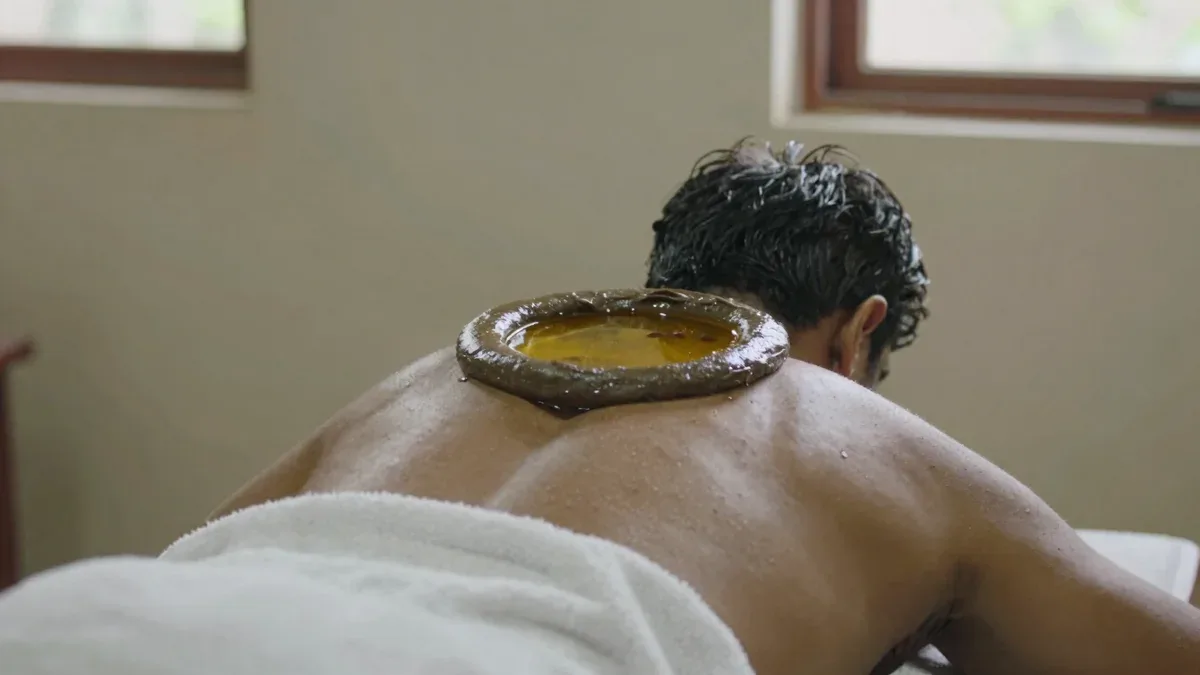
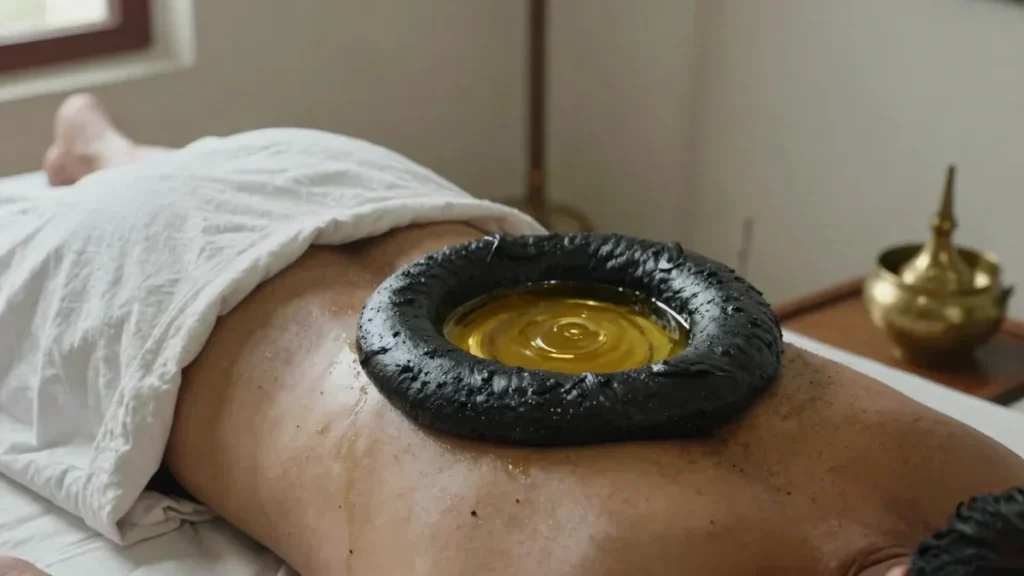
You lie face down. A ring of black gram (urad) dough is built over the painful part of the lower back. Warm medicated oil is poured into the ring and replaced every few minutes to keep the warmth steady, for about 30 to 40 minutes. Most people find it deeply relaxing and some fall asleep. It is not painful. Tell the therapist at once if the oil ever feels too hot.
Snehan and Patra Pinda Swed
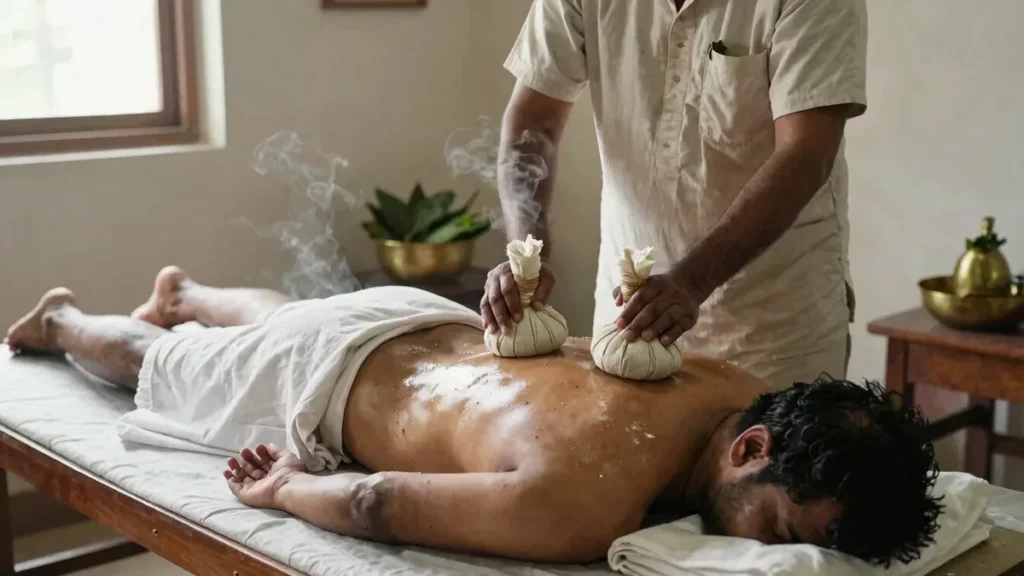
Before Kati Basti, warm oil is massaged into the lower back, hips and the back of the affected thigh and calf. Afterwards, cloth bundles (potli) of herbal leaves such as Nirgundi and Arka are roasted in oil and pressed along the back, buttock and leg. This moist, fragrant heat is often the part sciatica patients like most.
Basti (medicated enema)
Classical Ayurveda calls Basti the main therapy for Vata. For chronic or recurring sciatica, the doctor may plan a course that alternates oil (Anuvasana) and decoction (Niruha) Basti. This is a different procedure from Kati Basti, which involves no enema at all. Read more on our Basti therapy page.
Oral herbs
Classical formulas for Gridhrasi often use herbs such as Rasna, Nirgundi, Erand (castor), Shunthi (dry ginger) and Guggulu-based preparations. They are chosen for your type, digestion and other medicines, so please do not self-prescribe. Some Guggulu and castor preparations are unsuitable in pregnancy, with certain bowel conditions or with some prescription drugs.
What does the research say about Ayurveda for sciatica?
The evidence is encouraging but limited. Most studies are small, Indian and not blinded. They suggest Kati Basti, Matra Basti and Nirgundi can reduce pain and stiffness in sciatica and chronic low back pain. Larger, better-designed trials are still needed, so honest clinics present Ayurveda as supportive care, not a guaranteed cure.
- Nirgundi and Matra Basti (2010): In a study from Gujarat Ayurved University, Jamnagar, 102 of 119 patients with Gridhrasi completed treatment. Both groups improved, and the group that received Matra Basti along with Nirgundi Ghan Vati had better relief of signs and symptoms (Ali et al., Ayu, 2010).
- Kati Basti with two oils (2013): 90 patients with Gridhrasi were randomly split into two groups for 14 days of daily Kati Basti with either Sahacharadi Taila or Maha Narayana Taila. Both oils gave similar overall relief, with the greatest gain in functional ability (Mangal et al., Ancient Science of Life, 2013). This was an open study published as a conference abstract.
- Kati Basti added to yoga (2024): A randomised trial of 40 people with chronic low back pain compared one week of yoga alone with yoga plus Kati Basti. Both groups improved in pain, disability and mood at one week and three months, and the difference between groups was not significant (Bhatta et al., Journal of Ayurveda and Integrative Medicine, 2024).
That last result is worth reading carefully. It suggests that movement and daily habits do much of the work, and oil therapy supports them. This is why we never offer Kati Basti on its own without exercise and posture advice.
Ayurveda or modern treatment: which should you choose?
For most people it is not either-or. Modern medicine is essential for diagnosis, red-flag symptoms and severe nerve compression. Ayurveda helps with pain, stiffness, muscle spasm and lifestyle in uncomplicated sciatica, and many patients use both. The table below shows where each approach fits.
| Option | What it does | Best suited for | Things to know |
|---|---|---|---|
| Self-care: movement, heat, posture | Keeps the back mobile and eases spasm | Every case, from day one | The NHS advises staying active and avoiding long bed rest |
| Ayurvedic day-care (Kati Basti, Patra Pinda Swed, Basti) | Warm oil and herbal heat relax muscles and calm Vata | Mild to moderate, recurring or long-standing sciatica without red flags | Small studies only; works best with exercise and diet change |
| Physiotherapy | Structured exercises, nerve mobility and strengthening | Most people, especially after the first painful weeks | Fits well alongside Ayurvedic therapy |
| Pain medicines | Short-term pain control | Severe pain that stops sleep or work | The NHS notes paracetamol is unlikely to help and the benefit of ibuprofen-type drugs is unclear |
| Spinal injections or surgery | Reduce or remove pressure on the nerve | Severe compression, worsening weakness, pain not settling after months | Decided by a spine surgeon after an MRI |
How is sciatica treated at our Sarnath clinic?
At Vedic Panchakarma, sciatica treatment starts with a ₹500 consultation with Dr. Komal Maurya, including Nadi Pariksha (pulse assessment) and a look at your MRI or X-ray. If therapy suits you, the usual plan is the 7-day Low Back and Sciatica Care Programme, with one 75 to 90 minute sitting a day. You go home after each session.

- Consultation (₹500) The doctor takes your history, checks your pulse, reads your MRI, X-ray and medicine list, and screens for red flags. You get a written plan with the exact cost.
- Localised Snehan (15 to 20 min) Warm medicated oil on the lower back, hips and the back of the affected leg.
- Kati Basti (30 to 40 min) Warm oil held in a dough ring over the painful part of the lumbar spine.
- Patra Pinda Swed (15 to 20 min) Herbal leaf potlis pressed along the back, buttock and leg.
- Nadi Swed (about 10 min) Herbal steam on the lower back, then rest before you head home.
- Home plan on day 7 Diet, posture and a gentle movement routine to follow in the weeks after.
The full Low Back and Sciatica Care Programme costs ₹9,500 for 7 days, or ₹1,600 per day if you pay day-wise. Oral medicines, if prescribed, are charged separately and the doctor tells you the cost first. If stiffness runs along the whole back, the Whole Spine Care Programme (₹1,850 per day) may suit you better. All single-session rates are on our price list.
Patients often tell us what the experience felt like. Avanish Y. wrote in his Google review: “i have a problem in my spine after that i visit there and got relief in 1 week only.” Shweta Y., who came from Lucknow with back pain after a C-section, wrote that “Dr. Komal recommended sneha, swedan and potali panchkarma.” Every back is different, and results vary from person to person.
Not sure which programme fits your back? Send your MRI report on WhatsApp (+91 96822 22121) before you travel, or read about Dr. Komal Maurya and how she plans treatment.
What should you eat and avoid with sciatica?
Because sciatica is a Vata problem, food should be warm, freshly cooked, slightly oily and easy to digest. Cold, dry, stale and gas-forming foods tend to make Vata pain worse. Good digestion also matters, because constipation and gas are thought to aggravate Vata in the lower body.
- Eat more: dal-chawal or moong dal khichdi with a spoon of desi ghee, cooked vegetables like lauki and tori, a pinch of ajwain and sonth (dry ginger) in your tadka, warm water through the day.
- Eat less: fridge-cold water and chilled lassi, chana, rajma and other heavy pulses that cause gas, kachori and fried snacks, bakery biscuits, leftover or reheated fried food.
- Daily habits: keep an early, light dinner, avoid long fasting, and do not skip meals during a therapy week.
Varanasi winters deserve a special mention. The damp January fog off the Ganga is a classic Vata trigger. Keep the lower back covered on a scooter, avoid sitting on cold floors and use warm sesame oil on the back before a bath. See our joint and back pain guide for more on seasonal care.
Which sciatica exercises are safe at home?
Gentle, regular movement is one of the most useful things you can do for sciatica. Start slowly, stay within a mild stretch and stop any exercise that sends pain further down the leg. Short walks several times a day are often better than one long one. A physiotherapist can tailor a programme if pain is severe.
- Knee to chest: lie on your back, bring one knee towards the chest, hold for 20 to 30 seconds, then switch sides.
- Pelvic tilt: lie on your back with knees bent, flatten the lower back against the floor by tightening the tummy, hold for 5 seconds, repeat 10 times.
- Cat-cow (Marjariasana): on hands and knees, slowly arch and round the back with the breath, 8 to 10 times.
- Bridge (Setu Bandhasana, gentle): lift the hips a little off the floor, hold for a few breaths, lower slowly.
- Walking: 10 to 15 minutes on flat ground, two or three times a day, as pain allows.
Avoid toe-touching forward bends, heavy lifting such as gas cylinders, water drums or atta bags, and long two-wheeler rides on rough roads while the pain is active. When you sit for work, use a small cushion behind the lower back and stand up every 45 minutes.
When is sciatica an emergency?
Most sciatica is not dangerous, but a few symptoms mean the nerves at the base of the spine may be badly compressed. These need urgent hospital care, not Ayurvedic therapy. If you notice any of them, go to an emergency department straight away and do not drive yourself.
- Sciatica in both legs at the same time
- Severe or worsening weakness or numbness in both legs, or a dropping foot
- Numbness around the genitals or back passage (saddle area)
- Trouble starting to pass urine, being unable to pass urine, or losing control of bladder or bowels
- Back pain with fever, unexplained weight loss, a history of cancer or a recent fall or injury
See a doctor soon, though not urgently, if pain has not improved after a few weeks of home care, is getting worse, or stops your normal activities. Not sure where to start? Our treatment finder can point you in the right direction before you book.
Frequently asked questions
Can Ayurveda cure sciatica permanently?
No honest doctor can promise a permanent cure. Ayurveda can ease pain, stiffness and muscle spasm and help you change the habits that trigger sciatica. It does not change a bulging disc itself. Many people stay well with regular exercise, good posture and Vata-calming habits, and some choose a repeat course after a few months.
Is Kati Basti good for sciatica?
Kati Basti is one of the most used Ayurvedic therapies for sciatica. Warm medicated oil held over the lower back relaxes guarded muscles and eases stiffness. Small studies report relief in pain and function, but the evidence is limited. It works best as part of a course with Snehan, herbal heat and home exercises.
How many days does Ayurvedic treatment for sciatica take?
A typical first course is 7 days, with one sitting of about 75 to 90 minutes each day. Many patients feel looser after two or three sittings, while leg pain often takes longer to settle. Long-standing cases may need a longer Basti course, which the doctor plans after the consultation.
What is the cost of sciatica treatment in Varanasi?
At Vedic Panchakarma in Sarnath, the 7-day Low Back and Sciatica Care Programme costs ₹9,500, including one doctor consultation, or ₹1,600 per day if paid day-wise. A single Kati Basti session is ₹800. The first consultation with Nadi Pariksha is ₹500. Oral medicines, if prescribed, are charged separately.
Can I go to work during the treatment?
Yes. Our clinic is day-care only and open every day from 9 AM to 8 PM, so most patients book an early morning or evening slot and keep working. Try to avoid heavy lifting and long two-wheeler rides just after a sitting, and keep your lower back warm on the way home.
Will Ayurveda help a disc bulge seen on my MRI?
Ayurvedic therapy may ease the pain, stiffness and spasm that often come with a disc bulge, but it does not shrink or reposition the disc. Bring your MRI to the consultation. If the report or your symptoms suggest severe nerve compression, the doctor will advise you to see a spine specialist first.
Is hot or cold better for sciatica pain?
Ayurveda favours warmth for sciatica because Vata is cold and dry, and the NHS also suggests heat packs on painful areas. Use a warm compress or hot water bottle wrapped in cloth for 15 to 20 minutes. Avoid very hot packs if you have reduced skin sensation, such as from diabetes.
Conclusion: a calm, honest plan for sciatica
Ayurvedic treatment for sciatica works best as a short, doctor-supervised course built around Kati Basti, herbal heat, Vata-calming food and daily movement. It supports your recovery but does not replace a medical check when red flags appear. If your leg pain keeps coming back, a consultation can tell you whether therapy suits your back and what it will cost before you start.
Talk to us before you book
Call or WhatsApp us, every day 9 AM to 8 PM. Tell us your concern and we will suggest the right therapy or package and the cost before you visit.
Book on WhatsAppConsultation ₹500 with Nadi Pariksha · Open daily 9 AM to 8 PM
This article is general health information, not a diagnosis or a substitute for medical advice. Please consult a qualified doctor before starting any treatment or herbal medicine, and keep taking prescribed medicines unless your doctor advises otherwise. Seek emergency care at once for sciatica in both legs, numbness around the genitals or back passage, loss of bladder or bowel control, or rapidly worsening leg weakness.
Sources
- NHS, Sciatica (2024)
- Spine, Konstantinou K and Dunn KM. Sciatica: review of epidemiological studies and prevalence estimates (2008)
- Ayu, Ali M et al. A clinical study of Nirgundi Ghana Vati and Matra Basti in the management of Gridhrasi with special reference to sciatica (2010)
- Ancient Science of Life, Mangal G et al. A comparative study of Kati Basti with Sahacharadi Taila and Maha Narayana Taila in the management of Gridhrasi (sciatica) (2013)
- Journal of Ayurveda and Integrative Medicine, Bhatta M et al. Effects of yoga and add on Ayurvedic Kati Basti therapy for patients with chronic low back pain: a randomized controlled trial (2024)
Get the Vedic Panchakarma app
Special offer for everyone who downloads the app and books or takes a treatment.