Slip disc Ayurvedic treatment aims to calm pain, muscle spasm and nerve irritation with warm oil therapies such as Kati Basti, herbal heat, Basti and a Vata-calming diet, alongside gentle movement. It can help many people with a disc bulge or sciatica who have no serious nerve damage. It does not push a disc back into place, and it is not a replacement for surgery when surgery is truly needed.
Many readers search for this as स्लिप डिस्क का आयुर्वेदिक इलाज. Most slipped discs settle without an operation. This guide explains what Panchakarma can and cannot do, which therapies are used, how long a course takes, what it costs at our Sarnath clinic, and the warning signs that mean you should go to a hospital first.
What is a slip disc, in simple words?
A slip disc is a spinal disc whose soft inner gel bulges or leaks through its tougher outer ring and presses on a nearby nerve. The disc does not actually “slip”. Doctors call it a disc bulge, prolapse or herniation. In the lower back it often causes back pain and sciatica, a pain that runs down one leg.
The NHS lists the common symptoms as low back or neck pain, numbness or tingling in the arms or legs, trouble bending, muscle weakness, and pain in the buttock, hip or leg when the sciatic nerve is pressed. In the lower back, MRI reports most often mention the L4-L5 or L5-S1 levels.
Here is something that surprises many patients. A large 2015 review of spine scans in people with no back pain at all found disc bulges in 30% of 20-year-olds and 84% of 80-year-olds. So a bulge on your MRI is only part of the story. The doctor treats you, not just the report.
How does Ayurveda understand a slip disc?
Ayurveda sees most disc pain as a disturbance of Vata dosha, the principle of movement and dryness, settling in the spine and nerves. Back pain with radiating leg pain matches the classical condition called Gridhrasi (sciatica). Kati Shool means low back pain, and Greeva Graha means a stiff, painful neck.
Vata is described as dry, light, cold and mobile. Long hours of sitting, heavy lifting with a bent back, jerky two-wheeler rides on rough roads, cold exposure, poor sleep and irregular meals are all thought to aggravate it. So treatment uses the opposite qualities: oil, warmth, rest at the right time and grounding food.
Which Ayurvedic therapies are used for slip disc?
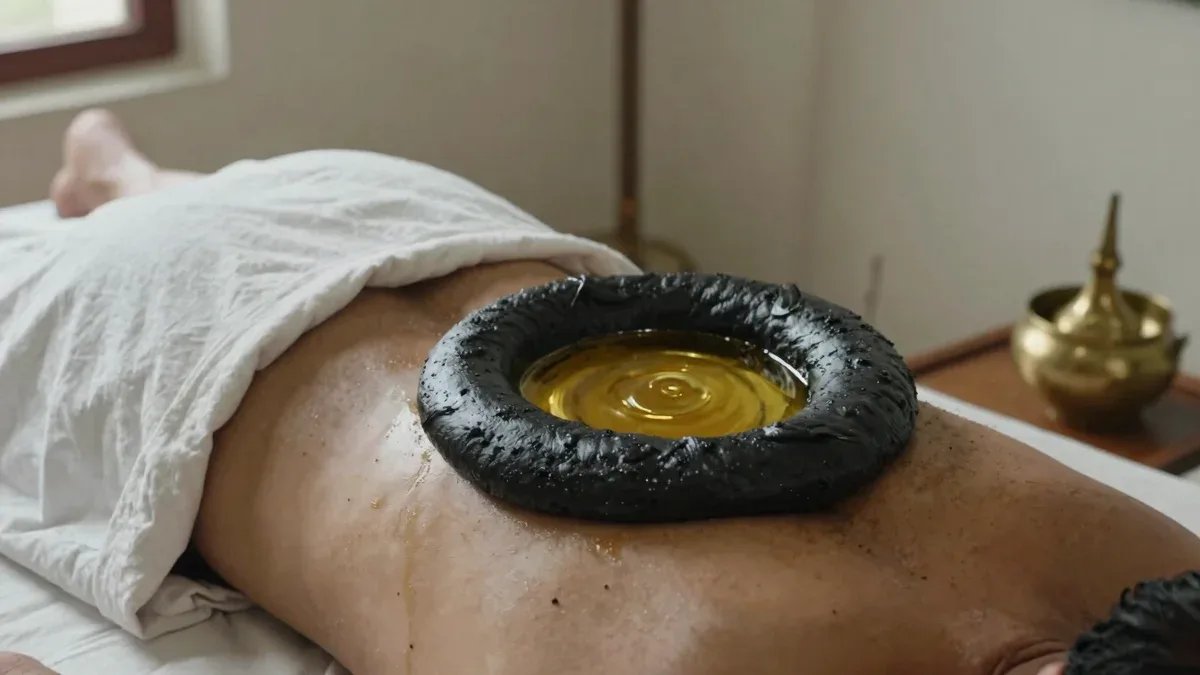
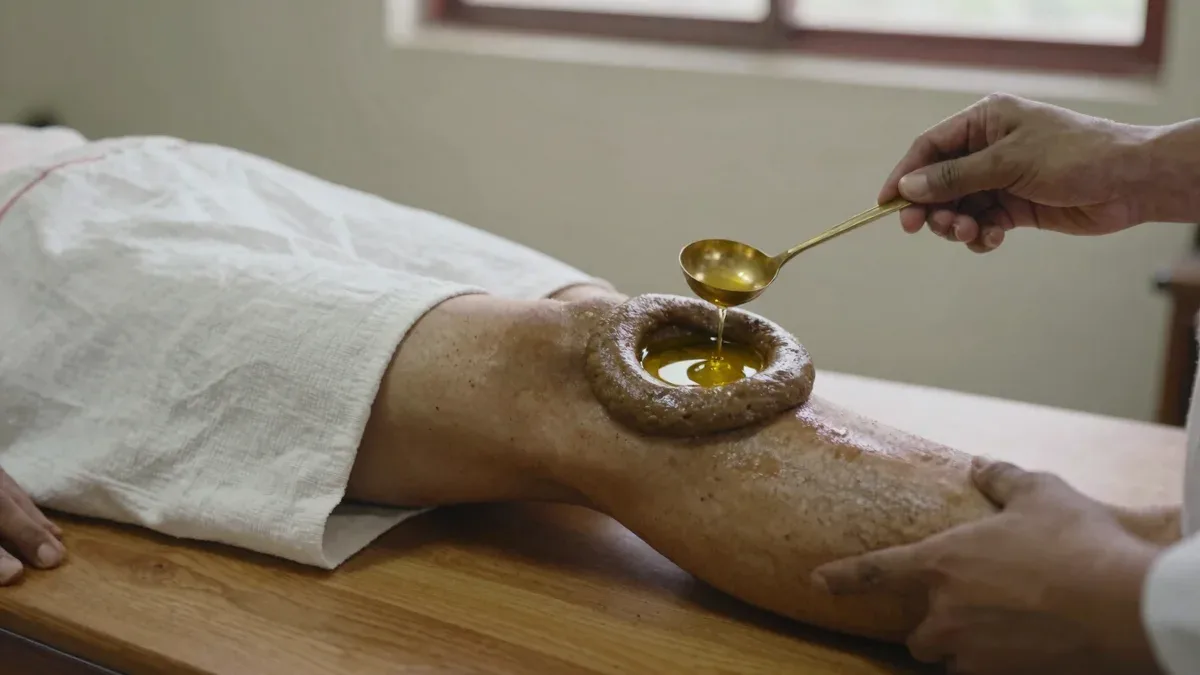
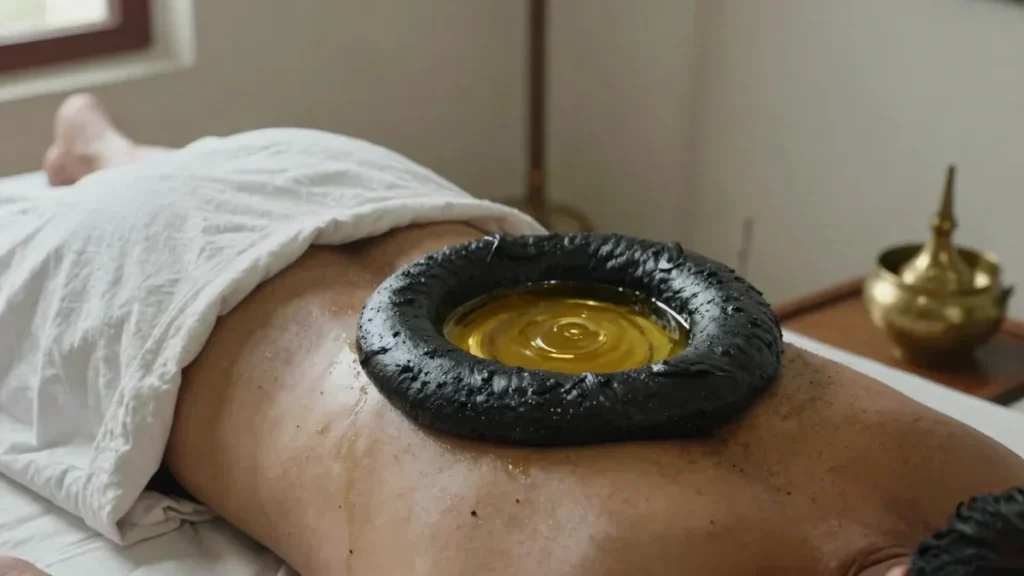
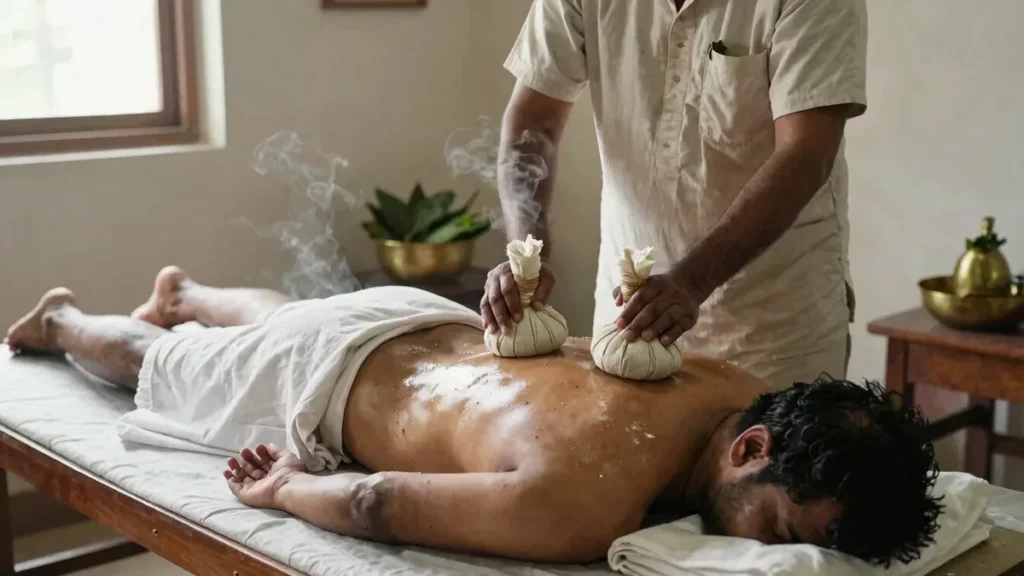
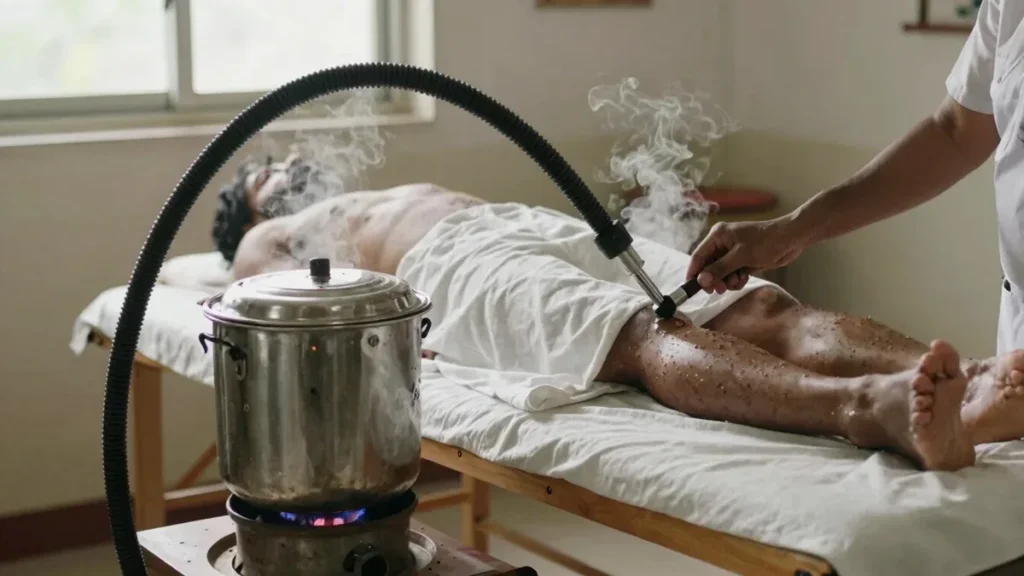
The main therapies for a lumbar slip disc are Kati Basti (warm oil pooled over the lower back), Snehan (oil massage), Patra Pinda Swed (heated herbal leaf bundles), Nadi Swed (local herbal steam) and, where suitable, Basti (medicated enema). For a neck disc, Greeva Basti replaces Kati Basti. The doctor picks the mix after examining you.
You can read more about the enema therapy on our Basti treatment page. Basti is not the same as Kati Basti. Kati Basti stays on the skin; Basti is an internal Panchakarma procedure.
What does the research say about Ayurveda for slip disc?
The research is encouraging but small. There are case reports and small studies, and no large, high-quality trial yet proves that Ayurveda shrinks a herniated disc. Honest clinics should say this plainly and treat Ayurveda as supportive, conservative care.
- A 2022 case report in the Journal of Ayurveda and Integrative Medicine described a 46-year-old woman with an L4-L5 extrusion who was nearly bedridden. After about seven and a half months of oral medicines, oils, fomentation and Basti, her disability score fell from 94% to 9%, and a repeat MRI showed less nerve compression. The authors note that the treatment still needs further evaluation. One case cannot prove that it will work for everyone.
- A 2013 conference study of 90 people with sciatica compared Kati Basti with two different classical oils over 14 days. Both groups reported almost the same relief. It was not compared with a placebo or standard care.
- A 2024 consensus from the World Federation of Neurosurgical Societies says that, in the absence of cauda equina syndrome or serious nerve deficit, conservative (non-surgical) care should be the first line of treatment for lumbar disc herniation.
Put simply: modern spine surgeons already recommend trying non-surgical care first in most cases. Ayurvedic therapy can be one part of that care, working alongside your doctor, physiotherapy and safe activity.
Ayurveda, modern conservative care or surgery: how do they compare?
For most people with a disc bulge and no serious nerve signs, the choice is not Ayurveda versus allopathy. It is which non-surgical care to combine, and when to escalate. Surgery is kept for specific situations. The table below gives a fair side-by-side view.
| Point | Ayurvedic care (Panchakarma) | Modern conservative care | Surgery |
|---|---|---|---|
| Best suited for | Back or neck pain, mild to moderate sciatica, stiffness, no red flags | Same group; first line for most disc cases | Cauda equina, worsening weakness, or pain not improving after proper care |
| Main tools | Kati Basti, Snehan, herbal heat, Basti, diet, oral herbs | Pain relief medicines, physiotherapy, staying active, sometimes injections | Removing the part of the disc pressing on the nerve |
| What it changes | Muscle spasm, stiffness, comfort, daily routine | Pain, inflammation, strength and movement | Directly takes pressure off the nerve |
| Can it reverse disc damage? | No | No | No, it removes the bulging part |
| Time off work | Usually none; day-care sittings of 75 to 90 minutes | Usually little | Hospital stay and weeks of recovery |
| Can be combined? | Yes, with modern care | Yes, with Ayurveda | Ayurveda may support recovery later, with the surgeon’s approval |
When is surgery or urgent care needed instead?
Go to a hospital immediately, not to a therapy clinic, if back pain comes with numbness around your bottom or genitals, trouble passing urine, loss of bladder or bowel control, or loss of feeling in one or both legs. These can be signs of cauda equina syndrome, a surgical emergency.
The NHS also advises seeing a doctor about a specialist referral if symptoms have not improved with other treatments, or if muscle weakness or numbness keeps getting worse. Pain after a serious fall or road accident, fever with back pain, or unexplained weight loss also needs a medical check first.
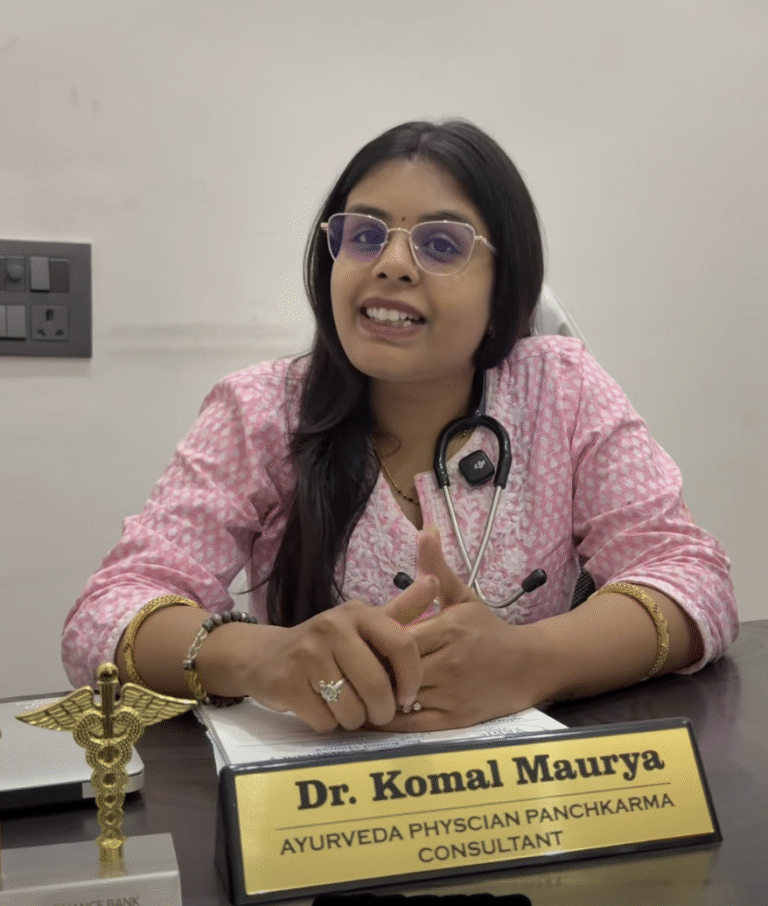
At our clinic, Dr. Komal will not start Kati Basti if any of these signs are present. She will refer you to an orthopaedic surgeon or neurologist. Ayurveda respects that some discs need an operation.
What happens in slip disc treatment at our Sarnath clinic?
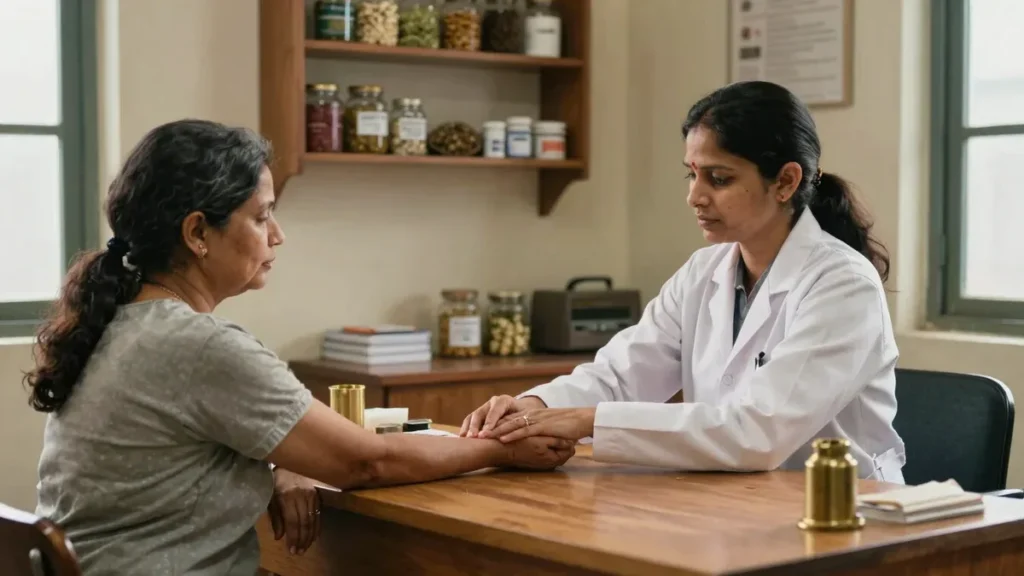
Treatment starts with a ₹500 consultation with Dr. Komal Maurya, BAMS, including Nadi Pariksha (pulse assessment), a look at your MRI or X-ray, and a check for red flags. If therapy suits you, it can begin the same day. You go home after every sitting.
- Consultation and screening The doctor takes your history, reads your MRI, checks leg strength and sensation, and looks for warning signs. Bring your reports and medicine list.
- Choosing the plan For low back and sciatica, the usual choice is the Low Back & Sciatica Care Programme. For pain along the whole back, Prishta Basti may be chosen instead.
- Localised Snehan Warm medicated oil is massaged into the lower back, hips and the back of the painful leg, about 15 to 20 minutes.
- Kati Basti You lie face down while warm oil is kept in a dough ring over the painful level, about 30 to 40 minutes.
- Patra Pinda Swed and Nadi Swed Herbal leaf bundles and then gentle steam warm the back and leg before you rest and go home.
- Home routine At the end, you get advice on posture, safe movement and Vata-calming food to keep the benefit going.
Here is what two patients wrote in their Google reviews. Avanish Y. said that he had “a problem in my spine” and “got relief in 1 week only”. Shweta Y. from Lucknow came with back pain after a C-section, and the doctor recommended “sneha, swedan and potali” therapy. These are individual experiences; your response may be different.
How many days does slip disc Ayurvedic treatment take?
A focused course for a lumbar disc is usually 7 days in a row, one sitting a day of about 75 to 90 minutes. The first day takes about 2 hours because of the consultation. Some people need a repeat course after a few months, and long-standing sciatica may take longer to settle than plain back pain.
Many patients feel their back is looser and warmer after the first two or three sittings, and getting up from a chair gets easier. Leg pain from sciatica often eases more slowly. The doctor reviews your progress during the course and adjusts the oil and heat.
How much does slip disc treatment cost in Varanasi?
At Vedic Panchakarma, Sarnath, the Low Back & Sciatica Care Programme is ₹1,600 per day, and the Whole Spine Care Programme is ₹1,850 per day. Neck disc care in the Cervical Programme is ₹1,600 per day. The first consultation with Nadi Pariksha is ₹500. A single Kati Basti session is ₹800.
Package prices include the therapies, medicated oils and herbs used in the session. Oral Ayurvedic medicines, if prescribed, are charged separately, and the doctor tells you the cost first. See the full list on our Panchakarma price list, or read what is included in the Low Back & Sciatica Care Programme.
Not sure which course fits? Book a ₹500 consultation with our Ayurvedic doctor in Varanasi and decide after the assessment. Pain along the full back may suit the Whole Spine Care Programme, and a neck disc the Cervical (Neck) Care Programme.
What should you eat and avoid with a slip disc?
Choose warm, freshly cooked, slightly oily food that calms Vata, and avoid cold, dry and gas-forming food. Lift nothing heavy, keep walking gently and avoid long bumpy rides during treatment. These habits help therapy work and protect the disc afterwards.
- Eat dal-chawal or khichdi with a spoon of desi ghee instead of dry rotis alone.
- Add a pinch of ajwain and sonth (dry ginger) to your dal tadka.
- Drink warm water; skip fridge-cold water and chilled lassi.
- Limit chana, rajma and fried snacks like kachori, which often cause gas.
- Do not lift gas cylinders, water drums or heavy atta bags.
- Get out of bed by rolling onto your side and pushing up with your arms.
- Use a small cushion behind your lower back when sitting.
Do not take oral herbs like guggulu-based tablets from the market on your own. They should be chosen by a qualified doctor who knows your other medicines, blood pressure and sugar levels. If you want to explore which therapy suits you, try our free treatment finder, or read about our wider approach to joint and back pain care in Varanasi.
Who should not have Kati Basti or herbal heat?
Kati Basti and herbal heat may not be suitable, or need changes, during pregnancy, fever or infection, a skin wound on the back, recent spine surgery, very high blood pressure, or diabetes with reduced skin sensation. Anyone with red-flag nerve signs needs hospital care first.
Do not stop any prescribed painkiller or other medicine on your own. Share your list at the consultation. The doctor will plan therapy around it and advise you to review medicines with the doctor who prescribed them.
Frequently asked questions
Can Ayurveda cure a slip disc permanently?
No treatment can promise a permanent cure. Ayurveda can ease pain, spasm and stiffness and support the body while the disc settles, which many discs do with non-surgical care. Keeping up posture, exercise and diet after treatment matters most for lasting comfort. We avoid “cure” claims.
Is Kati Basti good for L4-L5 disc bulge?
Kati Basti is commonly used for an L4-L5 or L5-S1 bulge because warm oil can relax the muscles around the painful level. Small studies report relief in sciatica, but strong trials are lacking. It is suitable only if the doctor finds no red-flag signs such as bladder problems or worsening leg weakness.
Can a slip disc heal without surgery?
Yes, in most cases. The NHS says surgery is not usually needed, and a 2024 neurosurgery consensus recommends non-surgical care first when there is no cauda equina syndrome or serious nerve deficit. Surgery is considered when symptoms worsen or do not improve with proper care.
How many sittings of Kati Basti are needed for a slip disc?
A typical course is 7 sittings on consecutive days, one per day. Some people need a repeat course after a few months, especially with long-standing sciatica. The doctor decides the number after examining you and checks progress during the week.
Can I continue my allopathic medicines during Ayurvedic treatment?
Yes, usually. Do not stop prescribed medicines on your own. Bring your medicine list to the consultation so the doctor can plan therapy around it. Ayurveda and modern care can be combined safely when both doctors know what you are taking.
What is the cost of slip disc Ayurvedic treatment in Varanasi?
At Vedic Panchakarma, Sarnath, the Low Back & Sciatica Care Programme is ₹1,600 per day and Whole Spine Care is ₹1,850 per day. The first consultation with Nadi Pariksha costs ₹500. Oral medicines, if prescribed, are charged separately and explained before you buy.
Is it safe to do Panchakarma with severe sciatica?
It depends on why the pain is severe. Strong pain alone is not a red flag, and gentle therapies can often be adapted. But numbness in the groin, bladder or bowel changes, or a weak foot that keeps getting worse needs emergency hospital care first, not Panchakarma.
The bottom line
Slip disc Ayurvedic treatment is a reasonable, gentle choice for many people with a disc bulge or sciatica and no serious nerve signs. Kati Basti, oil massage and herbal heat can ease pain and stiffness and help you move again. It works best as part of sensible conservative care, with honest limits and a quick referral when surgery is the safer path.
If you live in Varanasi, eastern UP, Bihar or are visiting, our clinic near Old RTO Chauraha in Sarnath is open every day from 9 AM to 8 PM. It is about 10 to 12 km (25 to 35 minutes) from Varanasi Cantt station. Message us on WhatsApp at +91 96822 22121 with your MRI and we will suggest a time.
Talk to us before you book
Call or WhatsApp us, every day 9 AM to 8 PM. Tell us your concern and we will suggest the right therapy or package and the cost before you visit.
Book on WhatsAppConsultation ₹500 with Nadi Pariksha · Open daily 9 AM to 8 PM
This article is general information, not a diagnosis or a substitute for medical care. Consult a qualified doctor before starting any treatment. Seek emergency care at once for numbness around the groin or bottom, loss of bladder or bowel control, trouble passing urine, loss of feeling in the legs, or rapidly worsening leg weakness. Individual results vary.
Sources
- NHS, Slipped disc (2024)
- World Neurosurgery: X, The role of conservative treatment in lumbar disc herniations: WFNS spine committee recommendations (2024)
- AJNR American Journal of Neuroradiology, Systematic literature review of imaging features of spinal degeneration in asymptomatic populations (2015)
- Journal of Ayurveda and Integrative Medicine, Conservative management of acute prolapsed inter-vertebral disc with Ayurveda: a case report (2022)
- Ancient Science of Life, A comparative study of Kati Basti with Sahacharadi Taila and Maha Narayana Taila in the management of Gridhrasi (sciatica) (2013)
Get the Vedic Panchakarma app
Special offer for everyone who downloads the app and books or takes a treatment.