Knee osteoarthritis ayurvedic treatment aims to ease pain, stiffness and swelling and to keep you walking, not to regrow worn cartilage. Ayurveda calls the condition Janu Sandhigata Vata: dry, aggravated Vata settling in the knee joint. Treatment usually combines warm oil therapies such as Janu Basti, herbal fomentation, gentle strengthening, weight care and, where needed, doctor-prescribed herbs.
It works best in early and moderate osteoarthritis, alongside your orthopaedic or physiotherapy care. Below we explain what Ayurveda offers, what the research really shows, how a 7-day knee programme runs at our Sarnath clinic, what it costs, and when surgery is the better answer.

What is knee osteoarthritis in Ayurveda (Janu Sandhigata Vata)?
In Ayurveda, knee osteoarthritis is called Janu Sandhigata Vata. “Janu” means knee, “Sandhi” means joint, and “Vata” is the dosha of dryness, cold and movement. With age, overuse or extra body weight, Vata builds up in the joint, the natural lubrication (Shleshaka Kapha) dries out, and the knee becomes painful, stiff and noisy.
Modern medicine describes the same picture as wear of the cartilage and changes in the bone under it. The classical signs match closely: pain on movement, swelling (Shotha), and a crackling feel when you bend the knee, which Ayurveda calls Sandhi Atopa.
How common is knee osteoarthritis in India?
Knee osteoarthritis is very common in India, especially after 60. A 2025 meta-analysis of 14 community studies found that about 47% of Indians aged 60 and above have knee osteoarthritis. Worldwide, the WHO estimates 528 million people lived with osteoarthritis in 2019, and the knee is the joint most often affected.
In Varanasi and eastern UP, daily life asks a lot of the knees: ghat steps, sitting cross-legged for puja, squatting in Indian-style toilets and long hours standing in kitchens or shops. Women past their mid-forties and retired men who have given up their morning walk form a large share of the knee patients we see.
Signs your knee pain may be osteoarthritis
Osteoarthritis usually starts slowly. Typical signs are pain when you climb stairs or get up from the floor, stiffness in the morning that eases within half an hour, crackling (crepitus) on bending, and mild swelling after a busy day. An X-ray confirms the diagnosis and shows the grade of wear.
- Pain that gets worse with walking or stairs and better with rest
- Short morning stiffness, or stiffness after sitting for a while
- A grating or crackling sound in the knee
- Gradual bowing of the legs in long-standing cases
Rheumatoid arthritis (Amavata in Ayurveda) looks different: both hands or many small joints, long morning stiffness, tiredness and sometimes fever. It needs a different plan, because heavy oil massage can make an Amavata joint worse. Our joint pain and arthritis treatment page explains these differences in more detail.
Ayurvedic treatment options for knee osteoarthritis
Ayurvedic treatment for knee osteoarthritis has three parts: external therapies to soothe the joint (Bahya Chikitsa), internal care to calm Vata and support digestion, and daily habits such as diet, exercise and weight control. The doctor chooses the mix after checking your knee, your reports and your Prakriti.
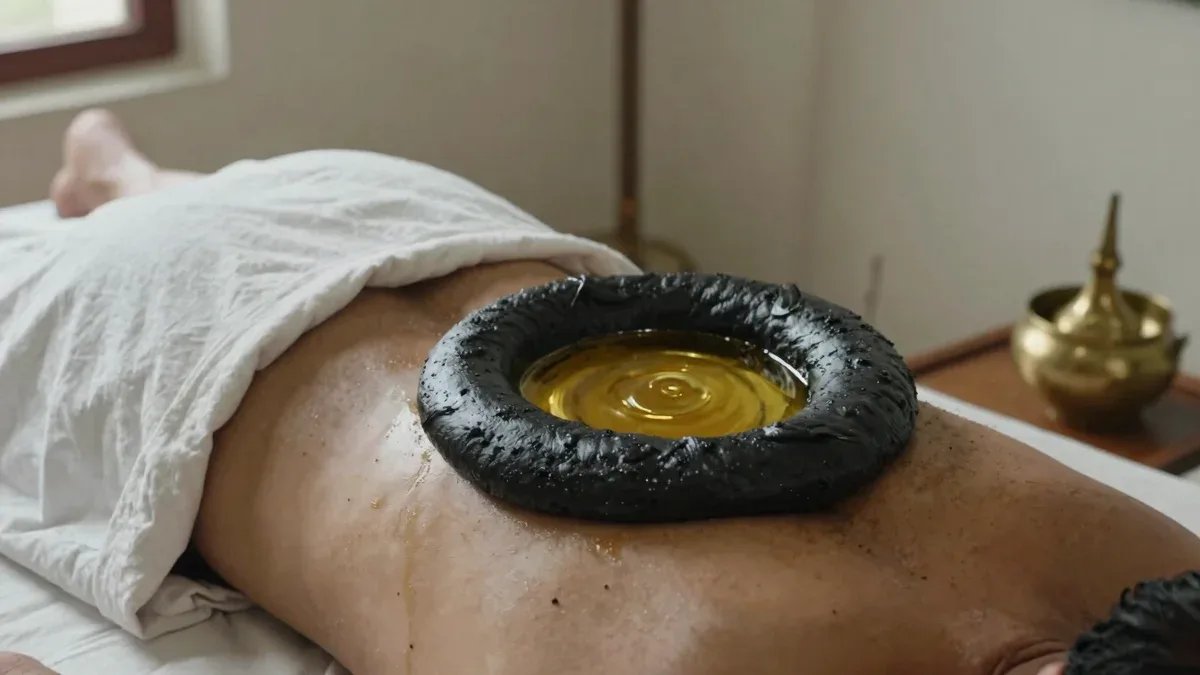
Janu Basti
A ring of black gram (urad) or wheat dough is built around the kneecap and filled with warm medicated oil. The oil is kept at a steady, comfortable temperature for about 25 to 35 minutes per knee. Many patients find it eases stiffness and makes the first steps after sitting easier. Both knees can be treated in the same sitting.
Snehan (local oil massage)
Warm oil is massaged around the knee, the thigh muscles above it and the calf below. Supporting the muscles around the joint matters as much as soothing the joint itself, so the therapist works the quadriceps carefully.
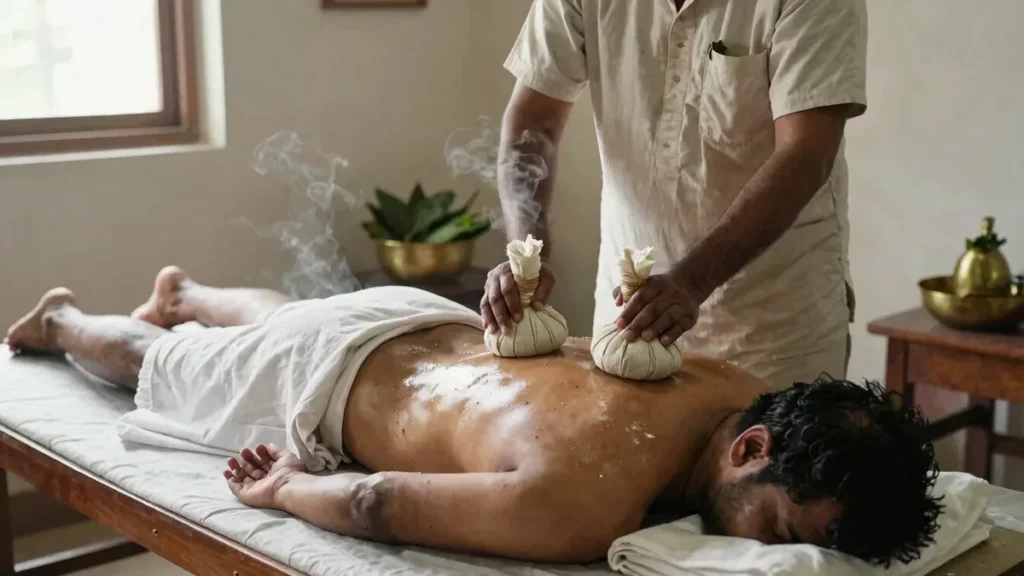
Patra Pinda Swed (herbal leaf bolus)
Leaves such as Nirgundi, Eranda (castor) and drumstick are lightly fried with oil, tied in cotton bundles and pressed around the knee and lower leg. The moist warmth is comforting for swollen, achy joints.
Nadi Swed (local herbal steam)
A narrow stream of herbal steam is directed at the joint for 5 to 10 minutes. It relaxes the area after oiling and helps the knee feel looser.
Basti courses and internal herbs
For long-standing or severe Vata, the doctor may advise a course of medicated enema (Basti), the main Vata therapy in Panchakarma. You can read how it works on our Basti therapy page. Herbs such as Shallaki (Boswellia), Guduchi, ginger and Amla are traditionally used for joint pain, and classical formulations like Yogaraj Guggulu are often prescribed. Take any herbal medicine only on a doctor’s prescription, because dose and liver safety need checking.
Does Ayurveda really work for knee osteoarthritis? What the research says
There is some good evidence, but it is limited. The strongest study is a 2013 randomised, double-blind trial of 440 patients in the journal Rheumatology. Standardised Ayurvedic herbal formulations reduced knee pain and improved function about as well as glucosamine and celecoxib over 24 weeks. Evidence for Janu Basti itself comes from smaller studies.
The same trial also found a rise in a liver enzyme (SGPT) in some patients, and seven patients on the Ayurvedic formulas were withdrawn; levels returned to normal after stopping. This is why we prescribe internal medicines carefully and may ask for liver tests on long courses.
A 2013 study in the journal Ayu gave 50 patients 15 days of combined Ayurvedic therapy for knee osteoarthritis. Most showed moderate to marked improvement, and no adverse reactions were reported. However, it had no control group, so it cannot prove cause and effect. Honest summary: Ayurveda can help pain and mobility, especially when combined with exercise and weight care, but larger trials on Janu Basti are still needed.
| Option | What it does | Good for | Limits |
|---|---|---|---|
| Janu Basti with Snehan and Swedan | Warm oil and heat to ease stiffness and pain | Early to moderate OA, morning stiffness | Does not rebuild cartilage; small study base |
| Doctor-prescribed Ayurvedic herbs | Internal support for pain and inflammation | Chronic pain alongside therapies | Needs dose control and liver monitoring |
| Exercise and physiotherapy | Strengthens thigh muscles that protect the knee | Every stage of OA | Needs regular practice to work |
| Painkillers (NSAIDs) | Short-term pain control | Flare-ups, on prescription | Stomach, kidney and heart side effects with long use |
| Knee replacement surgery | Replaces the badly worn joint | Advanced, bone-on-bone OA with deformity | Major surgery and rehabilitation |
The WHO lists exercise, healthy weight, education and, for severe disease, joint replacement as the core of osteoarthritis care. Ayurveda fits well alongside these, not instead of them.
Janu Basti benefits: what patients can realistically expect
Most people want to walk, climb stairs and sit without dreading it. Over a 7-day course, many patients report less morning stiffness and easier first steps after sitting. Some manage a flight of stairs with less pain, or notice that swelling settles. Changes are usually gradual and depend on how worn the knee is.
Janu Basti cannot reverse cartilage loss. What it can support is joint comfort, muscle relaxation and mobility, which makes a real difference to daily life. Patients often describe the experience itself as calming. One Google reviewer, Shweta Y., who came from Lucknow for back pain, wrote that the doctor “recommended sneha, swedan and potali panchkarma”, the same oil, heat and bolus therapies used for the knee. Another, Shreya S., wrote that the doctor “listens to every concern patiently and explains everything clearly.”
How our 7-day Knee Care Programme works
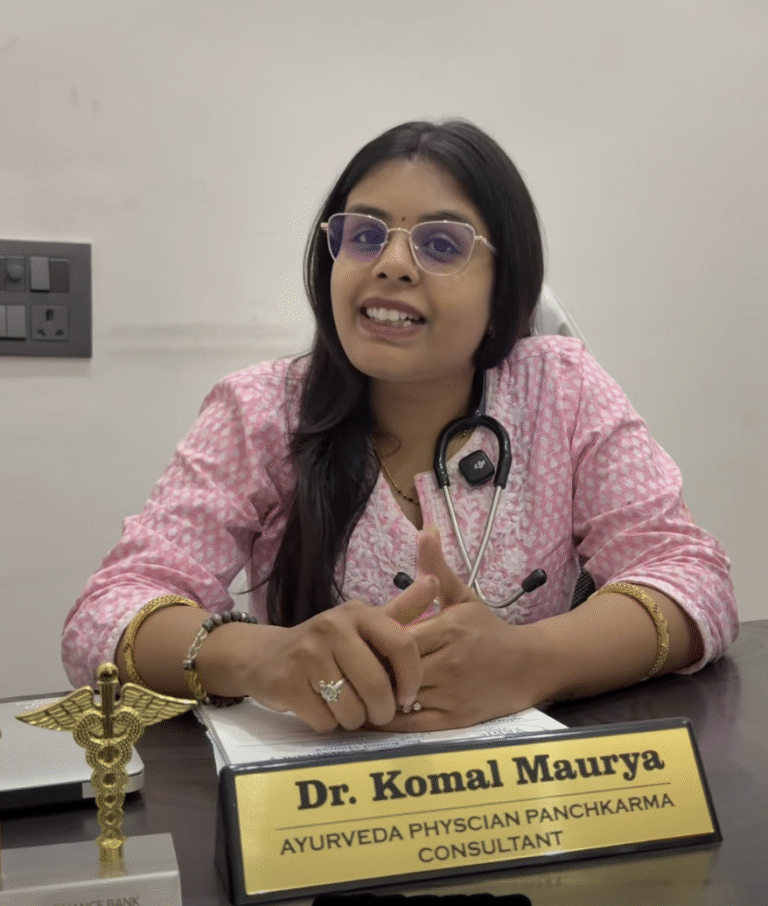
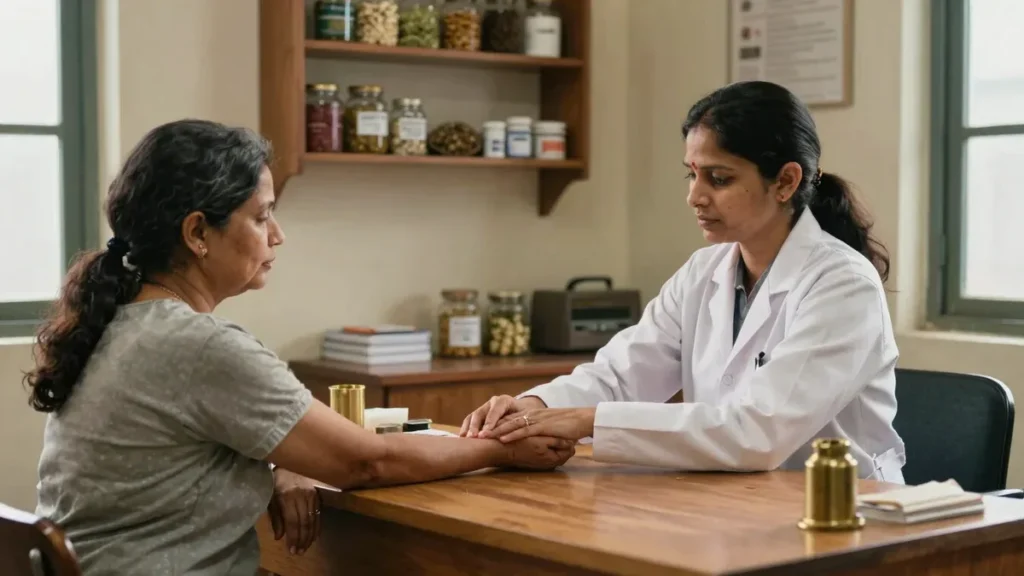
At our Sarnath clinic the knee programme is day-care: one visit a day for 7 days, about 60 to 80 minutes each, and you go home after every session. The first day includes a consultation with Nadi Pariksha and a knee examination. Every sitting is planned and supervised by Dr. Komal Maurya.
- Consultation (Day 1) The doctor takes your history, reads your pulse (Nadi Pariksha), examines both knees and looks at any X-ray or blood reports you bring.
- Local Snehan Warm oil massage around the knee, thigh and calf for about 15 minutes.
- Janu Basti Warm medicated oil held over one or both knees for about 25 to 35 minutes per knee.
- Patra Pinda Swed Warm herbal leaf bundles pressed around the joint for about 15 minutes.
- Nadi Swed Local herbal steam for 5 to 10 minutes, then rest and guidance on standing up without twisting.
- Home plan (Day 7) A final review with simple home exercises, footwear advice and a diet plan to keep the gains going.
Want the full day-by-day plan? See the Knee Care Programme (Janu Basti) page, or meet Dr. Komal Maurya first for a ₹500 consultation.
Cost of Ayurvedic knee treatment in Varanasi
At Vedic Panchakarma, Sarnath, the 7-day Knee Care Programme costs ₹9,500 in total, including the doctor consultation. You can also pay day-wise at ₹1,600 per day. A single Janu Basti session costs ₹800, and the first consultation with Nadi Pariksha is ₹500 if you book therapies separately.
| Service | Price |
|---|---|
| First consultation with Nadi Pariksha | ₹500 |
| Janu Basti, single session | ₹800 |
| Patra Pinda Swed or Nadi Swed, single session | ₹200 each |
| Knee Care Programme, 7 days (Janu Basti, Snehan, Patra Pinda Swed, Nadi Swed, consultation) | ₹9,500 |
| Knee Care Programme, paid day-wise | ₹1,600 per day |
| Oral Ayurvedic medicines | Only if prescribed; cost told before prescribing |
Full rates for every therapy are on our price list. The clinic is open every day from 9 AM to 8 PM, so family members can bring an elderly parent at a convenient time. Varanasi Cantt station is 10 to 12 km away (25 to 35 minutes).
Diet and daily habits for knee osteoarthritis
What you eat and how you move matter as much as the therapy. Ayurveda advises warm, light, easy-to-digest food that calms Vata, plus steady weight control, because every extra kilogram adds load on the knees. Gentle daily movement keeps the thigh muscles strong.
- Eat more: warm dalia, moong dal khichdi, seasonal sabzi like lauki, parwal and methi, and a teaspoon of ghee or til (sesame) oil in cooking.
- Kitchen supports: methi seeds soaked overnight, or a pinch of haldi in warm milk. Read more on turmeric benefits and safe dosage.
- Cut back on: curd and urad dishes at night, cold drinks, fried street snacks and very late dinners.
- Move smart: walk on flat ground in cushioned footwear, use a chair for puja, prefer a western-style toilet and avoid deep squatting during a flare.
- Keep knees warm: cover them on the scooter in the Banaras winter and avoid cold floors under bare feet.
- Strengthen: simple seated leg raises and straight-leg raises, as shown by your doctor or physiotherapist.
If extra weight is part of the problem, our Ayurvedic weight loss treatment can run alongside knee care. Hindi readers can also read घुटने के दर्द का आयुर्वेदिक इलाज और जोड़ों के दर्द की पूरी जानकारी.
When to see an orthopaedic doctor first
Some knee problems need an orthopaedic or emergency check before any Ayurvedic therapy. Go to a doctor promptly if the knee is hot, red and very swollen, if you have fever, if it swelled suddenly after a fall or twist, if it locks or gives way, or if you cannot put weight on the leg.
Advanced grade III to IV osteoarthritis with severe bowing or bone-on-bone changes is usually a surgical discussion. Ayurveda can still help with pain and comfort around it, but it will not rebuild the joint, and we will tell you plainly when a surgeon’s opinion should come first. Please check with the doctor before starting if you are pregnant, had knee surgery recently, have uncontrolled diabetes, varicose veins or skin ulcers on the leg, or take blood thinners.
Frequently asked questions
Can Ayurveda cure knee osteoarthritis permanently?
No treatment, Ayurvedic or modern, can fully reverse worn cartilage. Ayurveda aims to reduce pain and stiffness, improve walking and slow the problem through oil therapies, herbs, exercise and weight care. Many people with early or moderate osteoarthritis manage well for years with this approach, especially when they keep up the home routine.
What are the benefits of Janu Basti for knee pain?
Janu Basti holds warm medicated oil over the knee for about 25 to 35 minutes. Patients commonly report less morning stiffness, easier first steps after sitting and some relief on stairs. It is gentle and external. Research on it is still small, so we combine it with Snehan, fomentation, exercise and diet advice for the best chance of benefit.
How many Janu Basti sessions are needed for knee osteoarthritis?
Most knee plans start with 7 daily sittings, with a review at the end of the week. Long-standing or advanced cases may need 14 sittings, a Basti course or a few months of internal medicines. The doctor decides the number after examining your knee and reports, and adjusts it according to how you respond.
Can Ayurveda help me avoid knee replacement surgery?
Sometimes. In early and moderate osteoarthritis, many patients get enough relief and mobility to postpone surgery. In advanced disease with deformity and bone-on-bone changes, knee replacement is often the better answer. We assess your X-ray honestly and will advise an orthopaedic opinion when that is in your interest.
Which Ayurvedic medicine is best for knee osteoarthritis?
There is no single best medicine for everyone. Herbs such as Shallaki (Boswellia), Guduchi, ginger and Amla, and classical formulations like Yogaraj Guggulu, are commonly used. The right choice depends on your dosha, digestion and other illnesses. Take herbal medicines only on prescription, as a 2013 trial noted liver enzyme rises in some patients.
Is Janu Basti safe for elderly patients above 70?
Often yes, because it is a gentle external therapy. Before starting, the doctor checks blood pressure, skin condition, sugar control and general health, then adjusts the oil temperature and duration. People with reduced skin sensation, such as in long-standing diabetes, need extra care with heat, so always share your full medical history.
Should I stop my painkillers or calcium tablets during Ayurvedic treatment?
No. Do not stop any prescribed medicine on your own. Tell the Ayurvedic doctor everything you take, including painkillers, calcium, vitamin D and blood thinners. Any change should be discussed with the doctor who prescribed it. Ayurvedic therapy is meant to work alongside your existing care, not to replace it suddenly.
The bottom line
Knee osteoarthritis ayurvedic treatment is a sensible, gentle option for people who want relief from pain and stiffness without depending only on painkillers. Janu Basti, Snehan and herbal fomentation, guided by a qualified doctor and combined with exercise, diet and weight care, can make walking and stairs easier. It does not rebuild cartilage, and advanced knees may still need a surgeon.
If your knees are holding you back, bring your X-ray and reports for a ₹500 consultation at our Sarnath clinic, or message us on WhatsApp at +91 96822 22121. We will tell you honestly whether Ayurveda suits your knee and what a plan would cost.
Talk to us before you book
Call or WhatsApp us, every day 9 AM to 8 PM. Tell us your concern and we will suggest the right therapy or package and the cost before you visit.
Book on WhatsAppConsultation ₹500 with Nadi Pariksha · Open daily 9 AM to 8 PM
This article is general health information and does not replace a personal medical consultation. Ayurvedic therapies are prescribed after individual assessment, and results vary from person to person. Do not stop or change prescribed medicines on the basis of this article. Seek urgent medical care for a hot, red, very swollen knee, fever with joint pain, a knee injury with sudden swelling, or inability to bear weight.
Sources
- World Health Organization, Osteoarthritis fact sheet (2023)
- Journal of Family Medicine and Primary Care, Prevalence of knee osteoarthritis among elderly persons in India: a systematic review and meta-analysis (2025)
- Rheumatology (Oxford), Chopra A et al., Ayurvedic medicine offers a good alternative to glucosamine and celecoxib in the treatment of symptomatic knee osteoarthritis (2013)
- Ayu journal, Multimodal Ayurvedic management for Sandhigatavata (osteoarthritis of knee joints) (2013)
- NHS, Osteoarthritis: symptoms, causes and treatment (2023)
- NCCIH (NIH), Osteoarthritis: In Depth (2016)
Get the Vedic Panchakarma app
Special offer for everyone who downloads the app and books or takes a treatment.